No

When my children were young, there was a slogan promoted at every school in every grade, “Just Say No.” It was an effort to reduce the use of illegal and addictive drugs, and it echoes in my mind in so many other ways.

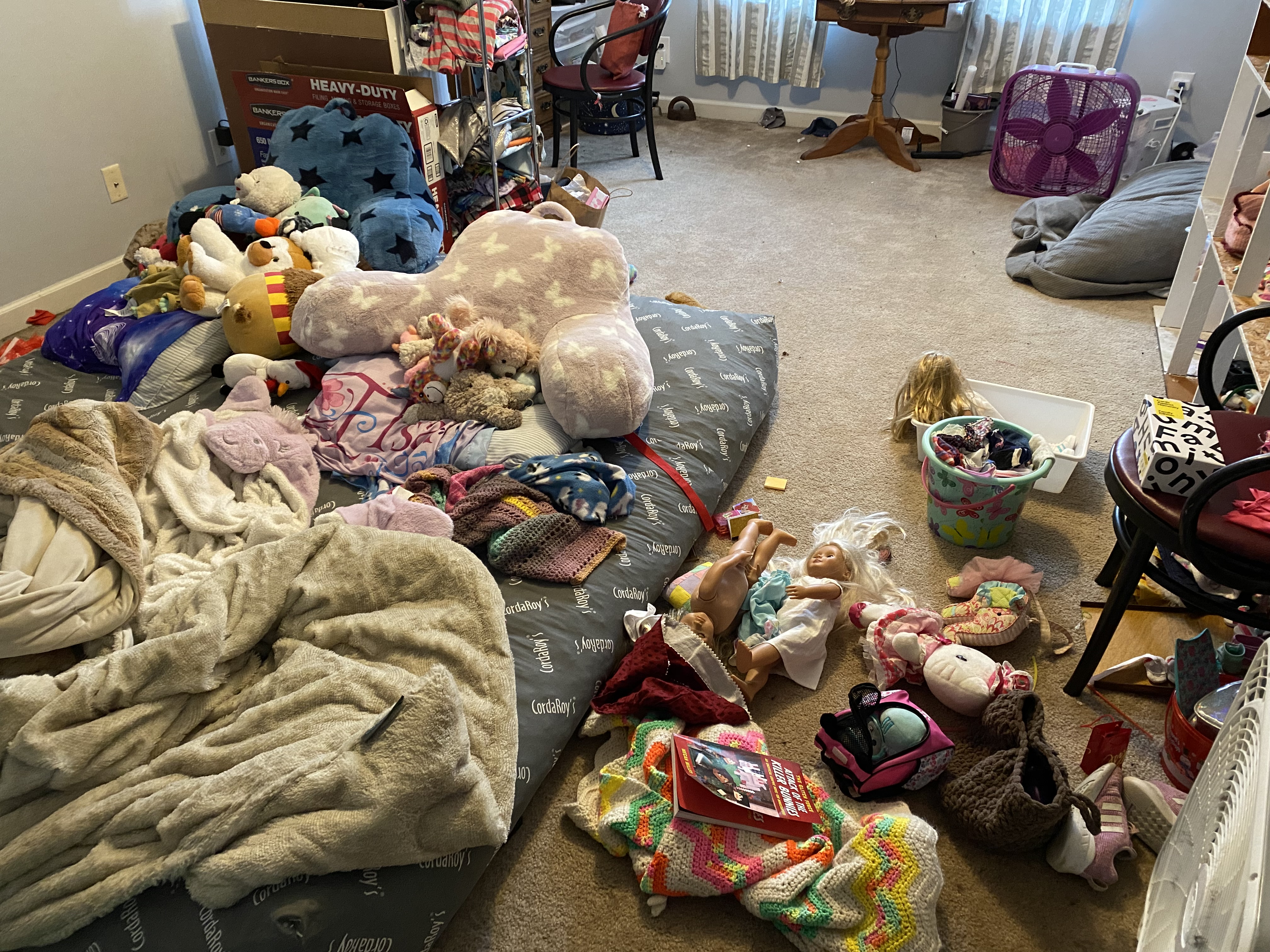
In a land of plenty, we are blasted with advertisements to purchase things, and more things. Most of us have more than enough. We should learn to “Just Say No.” Other times, people beseech us for contributions, no matter how small, for charities or political campaigns. Some of these are quite worthwhile causes. Some are not. We’ve been conditioned since our early days to listen and give in. Half of the adult population in America feels as if they can’t say no.

We don’t want to make waves. So we don’t say no.

We need approval in social settings. So we don’t say no.

We don’t want to appear stupid, or like we lack class. We want to latch onto whatever our idols do or have. So we don’t say no.

Yet experience has taught me we should learn how to turn down unnecessary solicitations, products, or activities. What we need and what we want are different things. If something will harm others, even on the other side of the globe, or exploit the planet we rely on, I should just say no. When I am asked to support a political candidate who promotes discrimination, selfishness, lethal weapons used against children, or hatred toward entire groups of people? A definite no.
What about plastic bags we use once and then pitch?

No. Too often these end up trashing someone else’s home town, or killing innocent wildlife.

Gas-guzzling cars and trucks?

No, especially with the EV alternatives taking off.

Products that use palm oil? Palm plantations decimate native equatorial rain forests. Don’t need that.

Another toy for a child who has too many already?

No.

More new clothes in my closet?

I have enough.

With every acquisition, more seconds of my day and more minutes of my remaining years are stolen from me by upkeep and maintenance. Possessions can become burdens if we aren’t careful to (you guessed it) say NO!

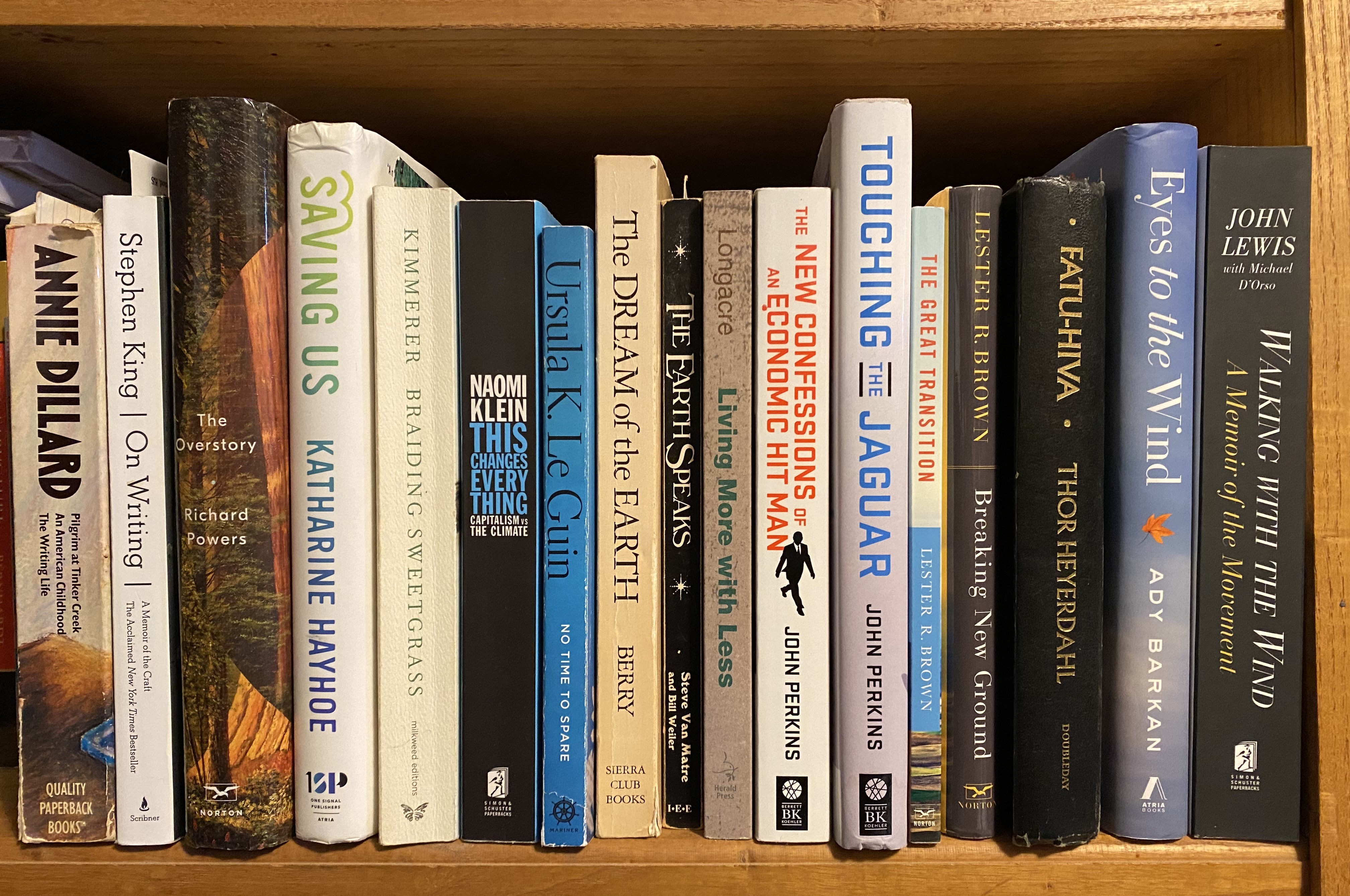
A growing number of economists and philosophers recognize the dangers of perpetual growth. In a finite system like the small planet we share with every other living thing we know,  unchecked economic growth–the basic idea of capitalism– destroys the foundations of what we need to survive. Check out Naomi Klein (This Changes Everything: Capitalism vs. the Climate) and Kohei Saito (Slow Down: The Degrowth Manifesto).

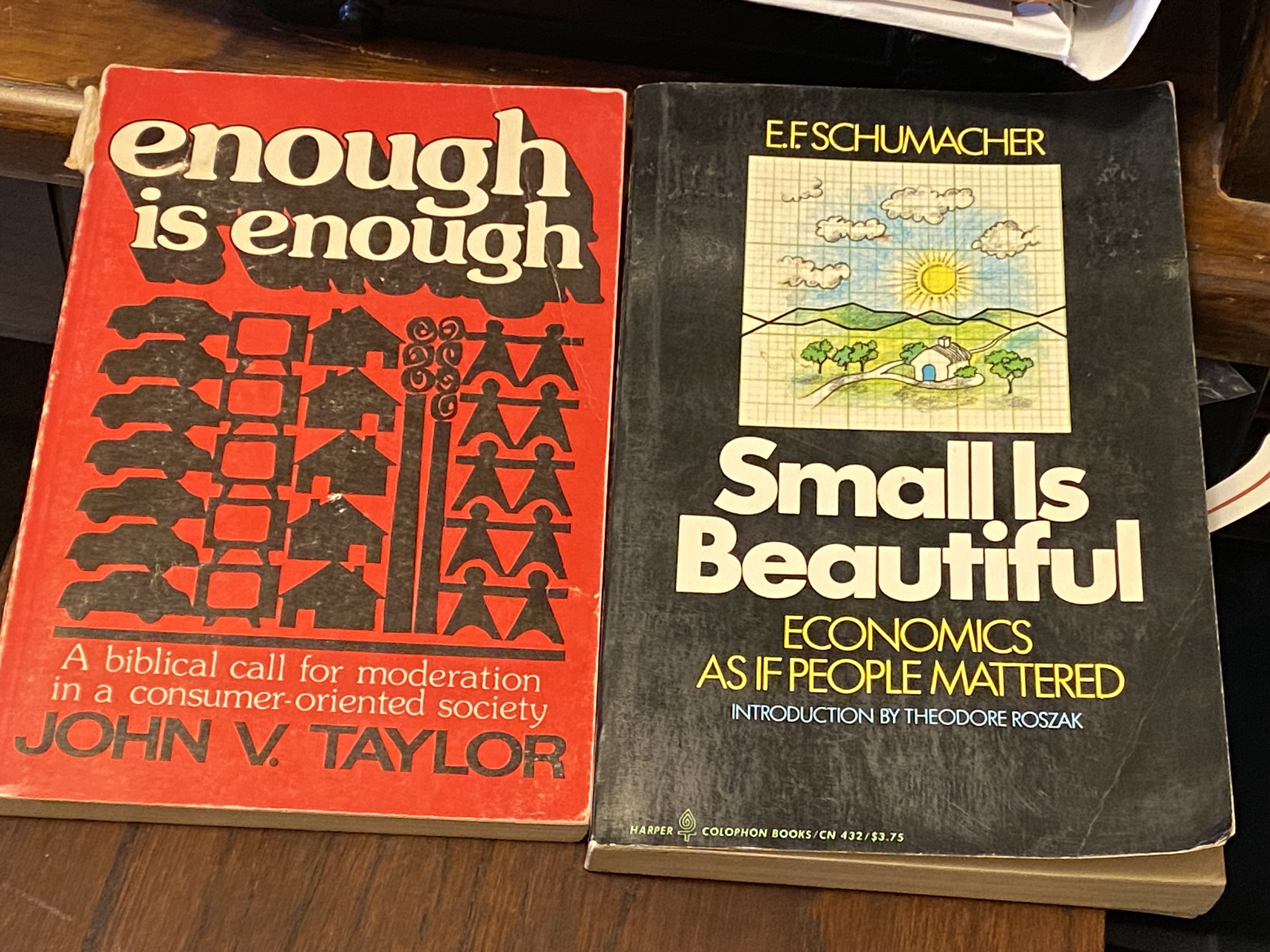
Enough truly is enough, especially when “more” involves bringing harm to others. I need to say “no” more often, to let go of purchasing whims, of the seduction of products and the ease with which we can order stuff online, “fundamentally useless things,” according to Saito. When will we learn? Letting go of the frenzy and learning to appreciate what we have leads to contentment, one of the highest of life’s art forms.

Embracing our Ancestors

I was not lucky enough to meet either of my grandfathers, but my grandmothers were very important to me. Marvin belonged to the same generation as my parents, so when he wrote about his grandfather, that was the generation prior to my own grandparents. The late 1800s was a time far too early to fret about human enterprise actually changing the whole biosphere (if that was even a word then) and causing mass extinctions. Trying to visualize life in those days is a fascinating exercise of the imagination.

From Marvin:

“I found a letter my grandfather wrote to my grandmother from New York City in 1888. He was going to medical school. She and their children lived in Randolph, Kansas, a small town completely obliterated by Tuttle Creek Dam. I thought how real and concrete their world seemed to them—as though it would never change—horses and buggies, no nuclear age. Once my grandfather told me he had lived in a golden age. He filled his clay pot with service to others. . . and I played within the boundaries of his smile.

“Our world is a dream world too, as theirs, wisping away, changing, reforming with new descendants. How can we best fill our clay pots? We know our clay fragments can’t be destroyed as molecules but what of us? Is there anything more important than adding another link to dream worlds?”

-Marvin Swanson


Many Facets of Grief

“This is so sad.” My husband said as he read a post on Facebook.

A former student of his, now working as a nurse in Wichita, had found her soulmate and recently became engaged to a man at the hospital where she worked. He was an EMT on helicopter runs. They excitedly planned a wedding and looked forward to their future together.

Then the helicopter he was on crashed in Oklahoma on a return flight from delivering a patient. Her fiancé, the love of her life, died in that crash. And her world fell apart.

It is sad. My husband looked at me and asked, “Do you think it would help her if we sent your book?”

He was referring to my memoir In the Shadow of the Wind, telling my own story from younger years of a lost love and how I was able to embrace life after the loss. “Someday maybe,” I answered. “This is too fresh for her. The book can be hard to read if your grief is fresh.”

It got me to thinking about grief again. We all experience the devastation of loss at times in our lives. To love someone is to risk heartbreak. One or the other in a loving relationship will someday face that inevitable loss. You just hope it will be years down the road, not tomorrow. But when a tragic accident happens, what can we do to help the survivor?

First, I think, we need to understand that every loss is complex. If no two people are identical, it can also be said that no two losses can be the same either. Nor is there any “proper” way to grieve. Each survivor has to find their own way forward, best done without others suggesting that they need to try a different approach, that their feelings are wrong, or mistaken.

There is no proper way to grieve. What we can do to help is just be there. Offer hugs, if hugs are wanted. Listen to a grieving friend without trying to solve a problem for them. Just listen. Give them a safe place to open their hearts and work through their grief.

It’s easy to understand the emptiness someone feels when they lose a friend, a fiancé, or a spouse. It’s perhaps more difficult to realize the many faces their grief takes on. The young nurse who lost her love already knows that the future they planned is gone. It no longer exists. She grieves for their lost years. Perhaps they talked of children. They too are gone, before they were born, along with all the family holidays and vacations, birthday parties, visits to grandparents, sports outings—everything that might have been is different now. It has changed and cannot be recovered. Each of those burst dreams compounds her feelings of grief.

What this newly bereaved nurse can benefit from are friends who listen as she rails against the universe and cries for her fiancé, and as she bemoans those babes who will never be born, as she lets go of the future they once dreamed together. She needs friends who wrap her in love and compassion and offer hugs to ease heavy arms that ache to hold her soulmate and those babes. She needs friends who travel the path with her as she lets go of a future that has evaporated in a fraction of a second, and give her permission to grieve in a way that works for her, never pushing her to be done with it, but recognizing that her journey is her own.

There is no right or wrong way to travel that road. The upheaval will grow easier with time, but the journey never ends. And each survivor’s path is unique.

A Matter of Perspective

I sat way up in the balcony at church a few weeks ago as an acquaintance rose to speak. Her contribution to the Sunday worship service was not planned, so there was no way to know she’d tell her story. But I’m glad she did. I found myself relating to life events and feelings she described which I would never have guessed she struggled with. I always thought she had her stuff together, if anyone did.

Me, on the other hand—well, whew! Like her, I experience self-doubt. I lack confidence. I struggle with self-esteem, feeling unworthy, inadequate, damaged. I’m not good enough. I don’t matter.

I do care. But what can little-old-me do to make a difference? Is there any point to trying?

This woman, a friend, a fellow mom who struggles still with an imperfect family—like me in so many ways—has the same feelings I do. The thought captivated me. I never would have guessed her history. I only know my own.

But her message reminded me of an important lesson I have learned and re-learned over the years. How I view myself is unlikely to be the same as how others view me.

I tell myself this often to bolster my courage, or to get out in the world, sometimes even to make a phone call. When I am down or I feel discouraged about a turn of events, when hopelessness creeps in and all I want to do is crawl into my friendly office and hide, that’s a good time to remember that how I feel about myself is not what others may feel. They may see me quite differently than I see myself. After all we wear many hats.

Perhaps it’s normal to think everyone feels what I feel and thinks what I think. But in reality, we all see the world—and each other—from our own unique perspectives. It’s the gift of a writer to help us see the world from other perspectives.

When we are able to do that, hope can be re-born. I may be one insignificant human in a sea of billions, but that shouldn’t discourage me from taking a stand on issues that matter. Though I feel inadequate and unsure of myself, I never know who else may be watching.

On the Power of Love

Love abides, though sometimes it goes into hibernation. Then the sound of a voice, a memory, an object, a passage from a book wakens it, and you know it has been there all the time. Sometimes a crisis awakens it. Sometimes standing on a peak of suffering before a cliff, it not only awakens but overwhelms you. It is the kind of love that transcends the love of a person for a person and embraces all.

-Marvin Swanson

Choices Make a Difference

“Do I HAVE to?” Who hasn’t grumbled those words? I’m guessing it’s a universal childhood lament when asked by a parent to handle one task or another.

This was fairly common when I was a girl. My sisters and I had responsibilities every day, along with weekly chores. Of course, we’d rather play with the neighbors, read a book, or watch TV. So, “Do I have to?”

To which the quick answer was, of course, “Yes. You have to.”

Until it wasn’t the answer. I can’t recall the task my dad asked me to tend to. Maybe it was helping set the table for dinner. Maybe it was drying the dishes which my sister washed. Maybe it was making my bed, or tidying my room, or raking leaves on our lawn. But whatever the request, my practiced response, shoulders drooping, was, “Do I have to?”

This time was different. My dad was likely tired. Perhaps he was exasperated after a long day at his job. Maybe he’d heard this phrase one too many times lately. Instead of responding with the expected, “Yes,” he sighed deeply and said, “No. There is really nothing on Earth that you ever have to do.”

His words. The message I got, however, was far deeper and is one I’ve never forgotten. If there’s nothing I ever really have to do, it’s what I choose to do that counts. That has stuck with me for over fifty years. The unspoken message influenced my life from that day forward. I may have hesitated after that day before I spouted the trite lament when I was asked to do my share. But I quit objecting to the chores. Rather, I chose to follow through and I learned it wasn’t so bad.

It’s kind of like Robert Frost’s two roads diverging in a wood. When faced with conflicting options, what I choose to do makes a difference.

Savoring the Middle Ground

Do you remember the Atlanta summer Olympics of 1996?

Who would unless you participated as an athlete, or lived in Atlanta, right? That seems an odd memory to bring up in January 2024, but I’ve been thinking about it often of late. Not that we attended the event in any way whatsoever, so maybe saying memories of the Atlanta Olympics skirts the edge of my topic. What I do recall is that there was a team of Georgia State Police officers that rode bicycles across the entire country in advance of the opening ceremony. They took turns carrying the Olympic Torch, so in effect, it was a relay across the country. And they rode right past our home.

The schedule and route were publicized accurately enough that we knew approximately when to expect them. We packed a quilt, snacks, and drinks, and set up a picnic at the end of our driveway to watch for the riders.

And we saw them!

This was back in the day of 35mm photography, when the internet and cell phones were in their infancy, so there was no easy video footage or sequence of still shots. But when the escort with flashing lights came over the rise leading the cyclists, I got my camera ready and took one good shot as the team rode past.

I’ve been thinking of this relay which brought the flame to the ’96 games as a metaphor for life. When the death of my father more than a decade ago put me in the family’s senior generation, I entered the Elder phase of life rather reluctantly. We age and we prepare to pass the flame on to the next generation, intentionally or not. But it happens.

As my own elders and mentors passed away, it fell to those of my generation to assist younger adults as they encountered the ever-increasing and dire challenges Earth residents face. We easily recognize what an elder is: someone on the downslope of life whose accrued wisdom can be beneficial to those on the way up the slope.

We might be less familiar with the term as a verb, an active and intentional process. To “elder” implies a conscious and willing sharing of lessons learned, offering our stories in a benevolent manner. Acceptance of what we share is completely voluntary by younger folks. But not to offer, not to continue our attempts to make things better for the coming generations—in other words, to give up—is not an option.

I ran across a note I’d written to myself years ago on the back side of a printed copy of the Prayer of St. Francis of Assisi.

“Giving up. It’s the original sin.” (Attributed to Anne Sullivan)

With this post, I introduce a category of “Eldering”. Through sketches of my younger years, I will offer some ideas, events, and lessons that were turning points for me. Eldering fits aptly in The Bridge blog since it effectively builds bridges from ancestors who have already left this life to the newest shining faces. We have lived through much in our decades, and been influenced even more by our own long-gone parents and grandparents, but there is much left to do. The future is built on the past and today’s needs are urgent. Letting go and giving up are not options. It’s time to savor the middle ground, to be a bridge from the ancestors to the children, to accept the torch and prepare to pass it on.


The Legacy of Marvin Swanson

When Covid rudely interrupted life for most of us, my series of Swanson quotations took a long break. This year I plan to return to sharing some special words left to me by my good friend, writing coach, and life mentor, Marvin Swanson. Though Marvin has been gone nearly 25 years, for me his memory lives on, as well as important lessons shared through the collection of letters he sent me.

Born in western Kansas in 1923, Marvin became afflicted with debilitating arthritis when yet a teenager. For over thirty years, he was an instructor of writing at Fort Hays State University and the University of Kansas, through correspondence courses. Living close to the campus of FHSU, he rented rooms to students and served as a mentor and a kind of foster-parent to those who shared his walls.

Marvin was a founding member of the Western Kansas Association on Concerns of the Disabled. The founding principle, possibly penned by Marvin himself, reads:

We, the members of the Western Kansas Association on Concerns of the Disabled, believe that all disabled persons, regardless of their disability, have the right to choose their own lifestyle. Along with this right comes responsibility. Therefore, we also believe that all disabled persons, no matter the degree of disability, can and should contribute something to society. We have dedicated ourselves and WKACD to the continuation of these principles.”

If contributions could be measured, those of Marvin Edgerton Swanson would rank among the highest humanity has to offer. Though imprisoned in a body wracked with pain, he transcended that condition. His mind, ever observant and quick to compile subtle nuances into gems of wisdom, connected with people of all ages to contribute to the betterment of life for all.

I met Marvin when I attended college at FHSU. We corresponded regularly until shortly before his death. His arthritis compromised his ability to wield a pen so he learned to polish the thoughts he inked onto his monogrammed stationery before writing them down. His letters were deeply well-planned in order to wring the deepest meaning from each word. When I read them again, he comes to life in my mind. The years drop away and it is almost as if I am young again, curled on his sofa, relating my thoughts to him in exchange for his ageless wisdom. Over the coming months, I plan to feature gems of Marvin’s wisdom gleaned from his letters.

Today’s gem reviews one I shared a few years ago, appropriately a few thoughts about letters.

I’ve been working on an article about the dwindling act of writing personal letters. Up to 80% of our reduced 1st class mail consists of business letters. Will the personal letter exchange gradually disappear in the electronic communication revolution? The personal letter has many unique advantages.

            Ellen Terry, an actress, began writing to George Bernard Shaw when they were both single. They never met. Both married. They wrote for 25 years. Shaw wrote about their correspondence, which has been published: “Let those who complain that it (the Shaw-Ellen Terry “romantic correspondence”)was all on paper remember that only on paper has humanity yet achieved glory, beauty, truth, knowledge, virtue, and abiding love.”

            Imagine, I can read a letter Christopher Columbus wrote describing America or Edgar Allen Poe’s letter revealing the secret of the real tragedy of his life. They’re in a book with many more entitled The World’s Great Letters.  I have it.

            “Letters . . . are, of all the words of men, in my judgment, the best.” (Francis Bacon)