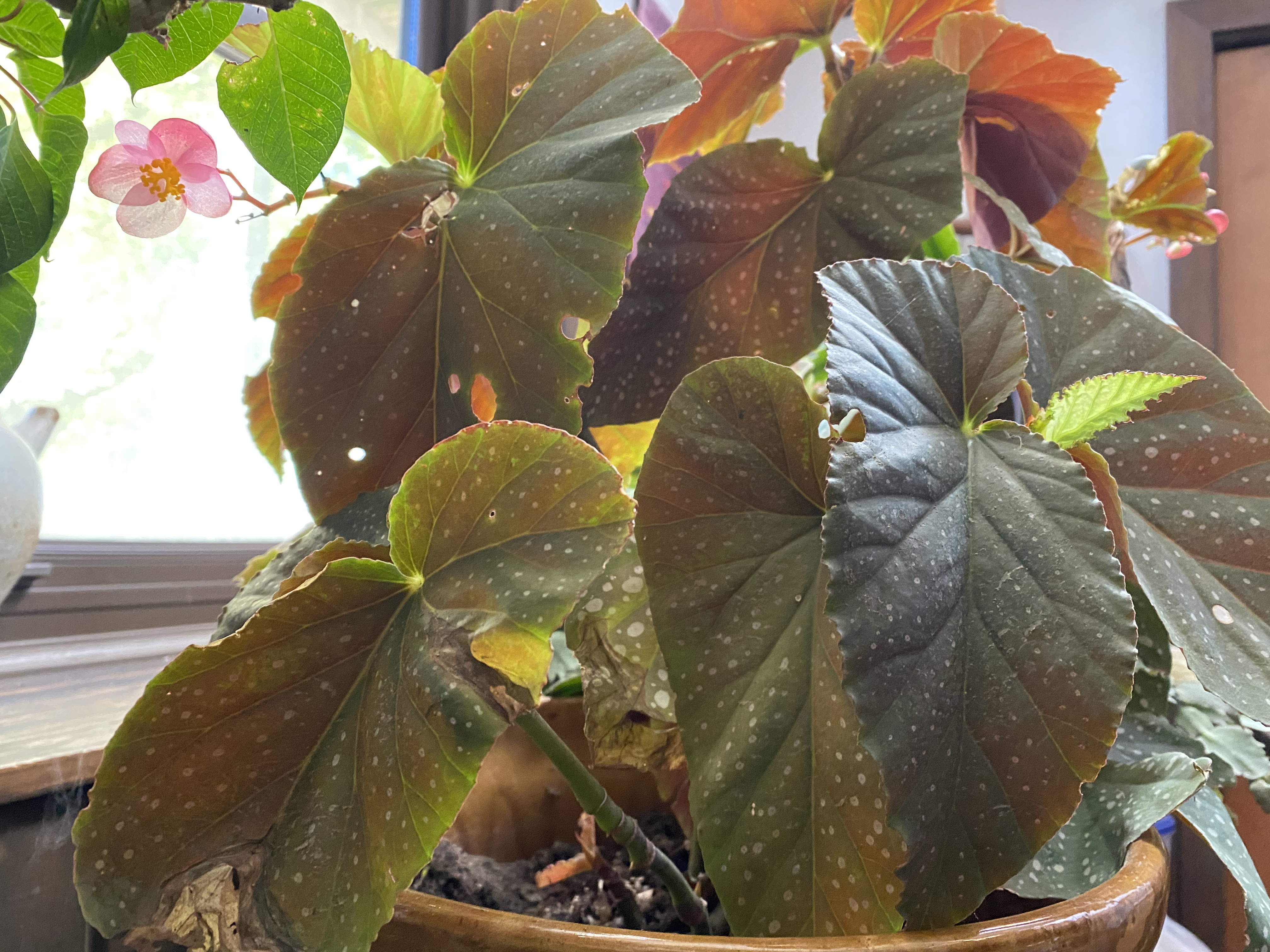
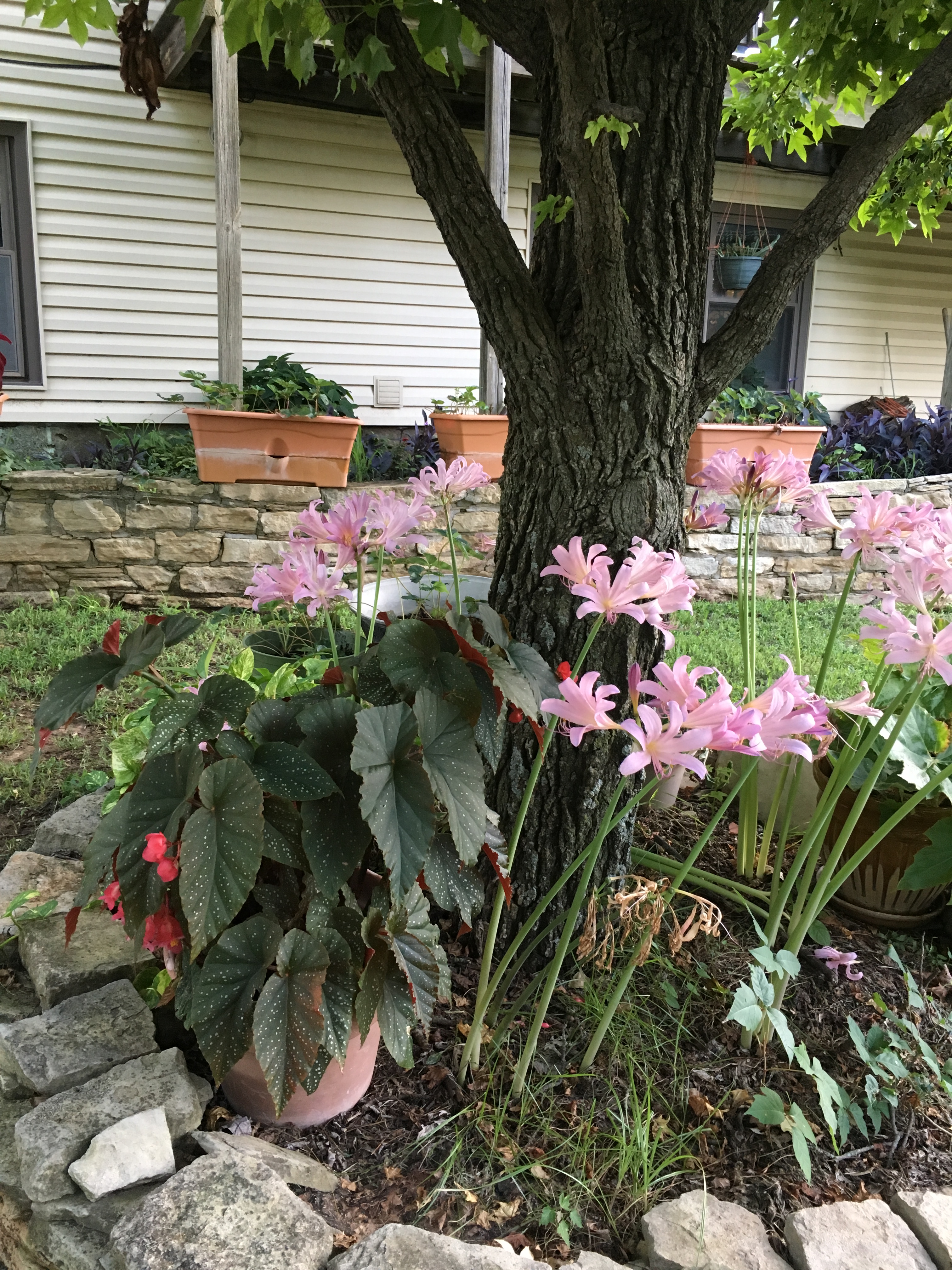
I conclude my series on Plants that are some of my Favorite People on this last day of 2025 with a tribute to a cherished begonia and the people she represents. Long ago, my Grandma Georgia tended her angelwing begonia in the west window of her front room. The stand beneath it was likely crafted by my dad, her son, in his woodworking shop. All of her grandchildren noticed this solitary plant, the only one she kept inside. Its showy speckled leaves were indeed shaped like wings, with many colors—from green to red, and silver speckles. Grandma told me that she had received this begonia from her mother, who got it from her mother, and so on and so forth. It is a living family heirloom. The cuttings keep going over many generations, and decades, and multiple centuries. Who is to know how old this plant really is? For Grandma, it dated back to the 1800s. It’s now part of my 21st century garden.
And so the angelwing begonia is esteemed in my collection. It represents the family’s values—among which are resilience, persistence, continuity, and devotion. It is determined and dedicated, regardless of its human caretakers, and just keeps on keepin’ on, fulfilling the purpose the universe has assigned to it.
My treasured angelwing begonia has graced my window ledge in winter and the outdoor planting beds in the summer for many years. Like Grandma Georgia, I have shared cuttings with cousins, sisters, nieces, and friends. With appreciation for the begonia’s connection to my grandmother, I saved this post for the last in the series for two reasons. One was the reminder of the cyclical nature of life on earth and the resilience of life as we prepare to welcome a new year. May the begonia deliver hope for the weeks and months to come.
The second was to honor the memory of a dear cousin who passed away one week ago today, on the day before Christmas. Like my sisters and me, she was a granddaughter of Grandma Georgia. One of my favorite memories of Maureen is her quiet request for one of the begonia cuttings a few years ago. I prepared one for her and we met in the parking lot of the Episcopal Church in Derby for the exchange. Now my angelwing begonia connects me to her as well as other loved ones who have donned their own angel wings in the great beyond.
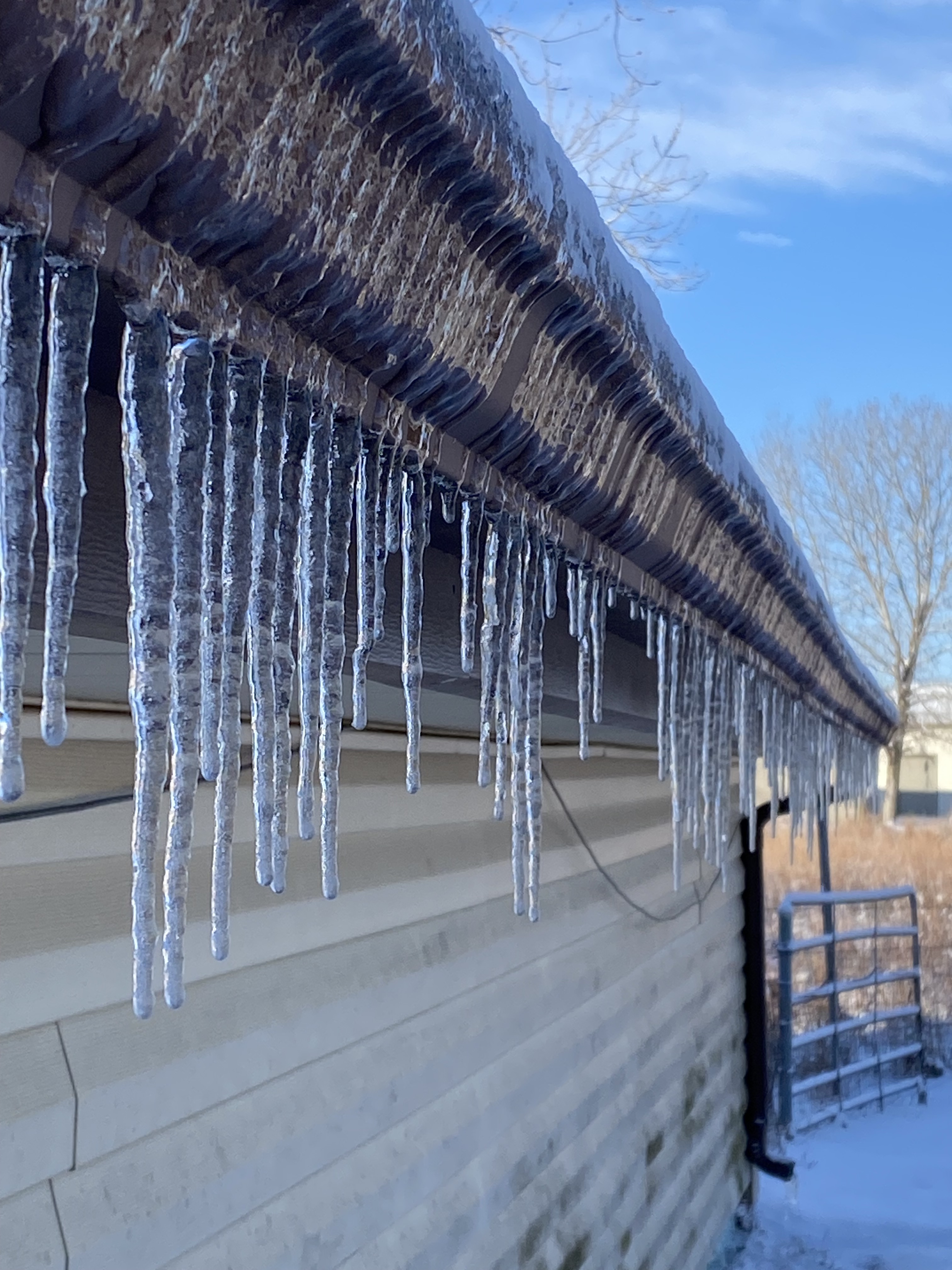
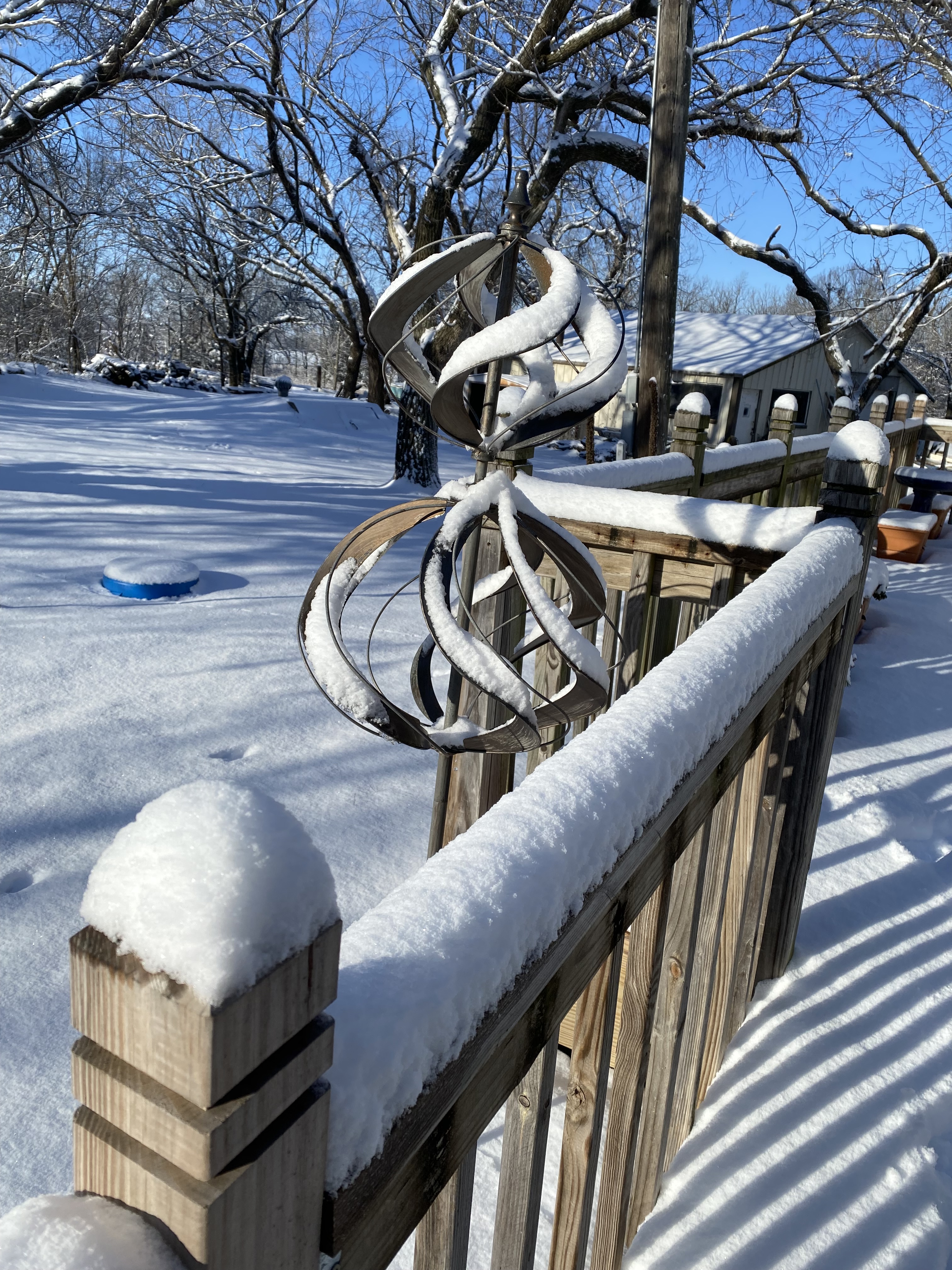
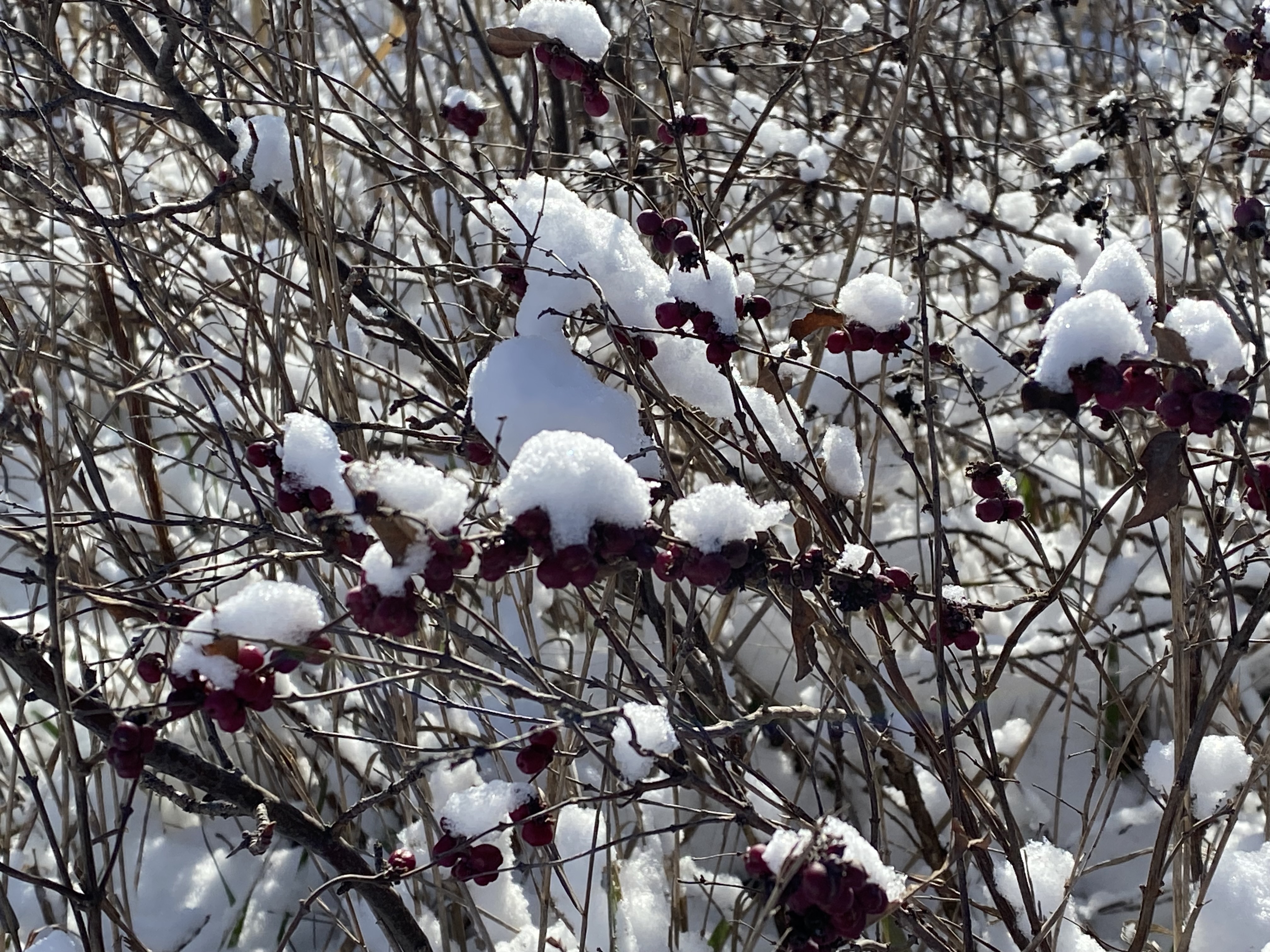
Seventy-three years ago today, at 10:10 in the morning, a baby boy arrived in this world who would become a significant part of my life. Two decades later, I met Craig Winter in college at FHSU. We enjoyed traipsing around public parks and nature reserves in Kansas with our cameras, taking pictures of the wonders of nature. This morning I celebrated his life with a walk in the winter wonderland, taking a few pictures of the snow that fell overnight.
Craig and I were married in 1977, during Jimmy Carter’s presidency. Having taken a class in the biology department at FHSU together–a class called “Can Man Survive?” that examined all the environmental issues of the day, including the greenhouse effect and global warming as climate change was called then–we were united in our commitment to support the natural world and reduce humanity’s harmful effects that were due to our unmitigated greed. Jimmy Carter was our guy. They say he was ahead of his time. I don’t think so. The probability of a global consequence to our short-sighted ravaging of our planet was known more than 100 years ago. Society knew all the benefits of alternative energy in the 60s and 70s. But harnessing free energy from the sun didn’t make any corporations much money. Craig and I were supporters of Carter’s conservation methods–turn down the winter thermostat, 55 mph speed limit, his installation of solar panels on the White House. And we dreamed of becoming reliant on our own private energy production, even then.
Carter acted with the well-being of his neighbors in mind, a true Christian quality. He wasn’t ahead of his time. The “resistance” at that time was just way behind. Look where that got us as they gained and assumed power.
Craig became a cancer statistic 9 days after his 33rd birthday in 1985, and I became a widow. (Quite the stigma for someone not yet 30 years old.) But I haven’t forgotten our joint priorities, nor our admiration for President Jimmy Carter.
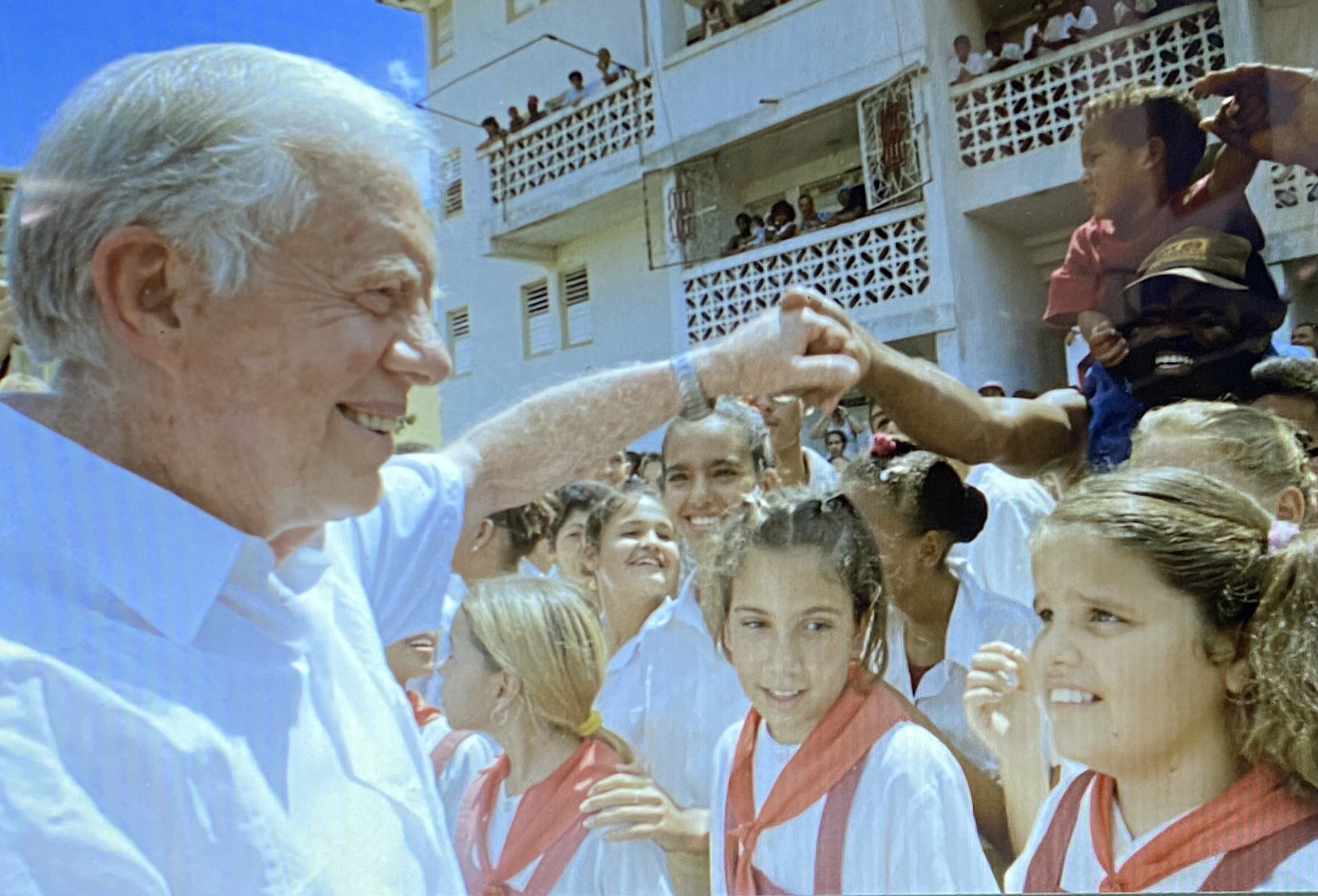
Photo courtesy of The Carter Center. Cuba 2002–The Carter Center’s delegation to Cuba, being the first time since the 1959 Revolution that a sitting or former president visited Cuba.
After his time in office ended, President Carter showed that you don’t have to be the elected leader of the country to make a huge difference, and today, a day after President Jimmy Carter’s funeral in Washington, DC, I renew my commitment to make a difference for those in my circle, for the inhabitants of Earth’s future, and for all the non-human neighbors that are as dependent on this planet as we are dependent on their well-being. Those of us with the future of our planet and its life forms in mind are now the “resistance.”
This morning, in honor of Craig Winter, I was trekking around our acreage in the fresh snow with my camera, capturing scenes, just like we used to do. Thinking of you Craigie, as I always do on this day. With love.
NOTE: I am deeply grateful and indebted to my second husband, Mike, for his generous and compassionate heart for the last 36 years. He has never objected to my memories or to my honoring people from my personal history that helped make me what I am today. We are all products of our histories and our memories, not just the stimuli we receive at the present time. Thank you for being dad to all our children, and grandpa to all our grandchildren as well as allowing my heart to grieve through the years.
Remember what it was like. After a long wait, it finally happened. With guarded optimism, you look forward to the big event. Though you know things can happen, chances are you won’t be in that slim margin. So you dance. You laugh. You hug everyone and share the good news. You imagine life after the event, the realization of a dream come true. The anticipation of anniversaries, holidays, and journeys to wondrous locations, savoring the unfettered excitement as your long-awaited dream discovers the world. Never a dull moment. Of course there will be challenges, but nothing you can’t work through and be stronger for it. You look forward to years of living, loving, and learning together.
Until there are none.
It all comes crashing down. Something was wrong at a routine checkpoint. No heart beat. Emergency trip to the hospital. Before you have time to process the news, joy morphs into heartbreak. A birth becomes a funeral. It’s over. Dreams die hard.
After November 5, it struck me how similar the election loss was to the loss of an infant. Though it’s been decades ago, I feel the same sad aimless wandering and hopelessness with the election results as with my two sweet babes who died before they had a chance to live. Gone are the anticipated celebrations and birth anniversaries. Gone are all the anticipated years of discovering the world together. Gone are the memories and the history I looked forward to making.
Every morning brings more bad news to my inbox and I move through life on the verge of tears, almost—yet not quite—ready to open the floodgates.
How will I manage the coming hard times? How will I step forward, keep moving, go through the motions, when my heart is sorely wounded? How can I show up for others when I can’t even manage to cheer myself up? Where did all the good in the world, all the anticipated conquests of our precarious future—where did they go?
One of the writers I follow suggested asking two questions every day.
What do I still know and believe as truth?
Is my heart still beating?
In other words, my values remain and I can embrace them until my dying breath. It reminds me of the weeks and months following the burials of my sweet babes. It’s been forty years. (Almost 43 for the first and 42 for the second.) How did I work through the devastation?
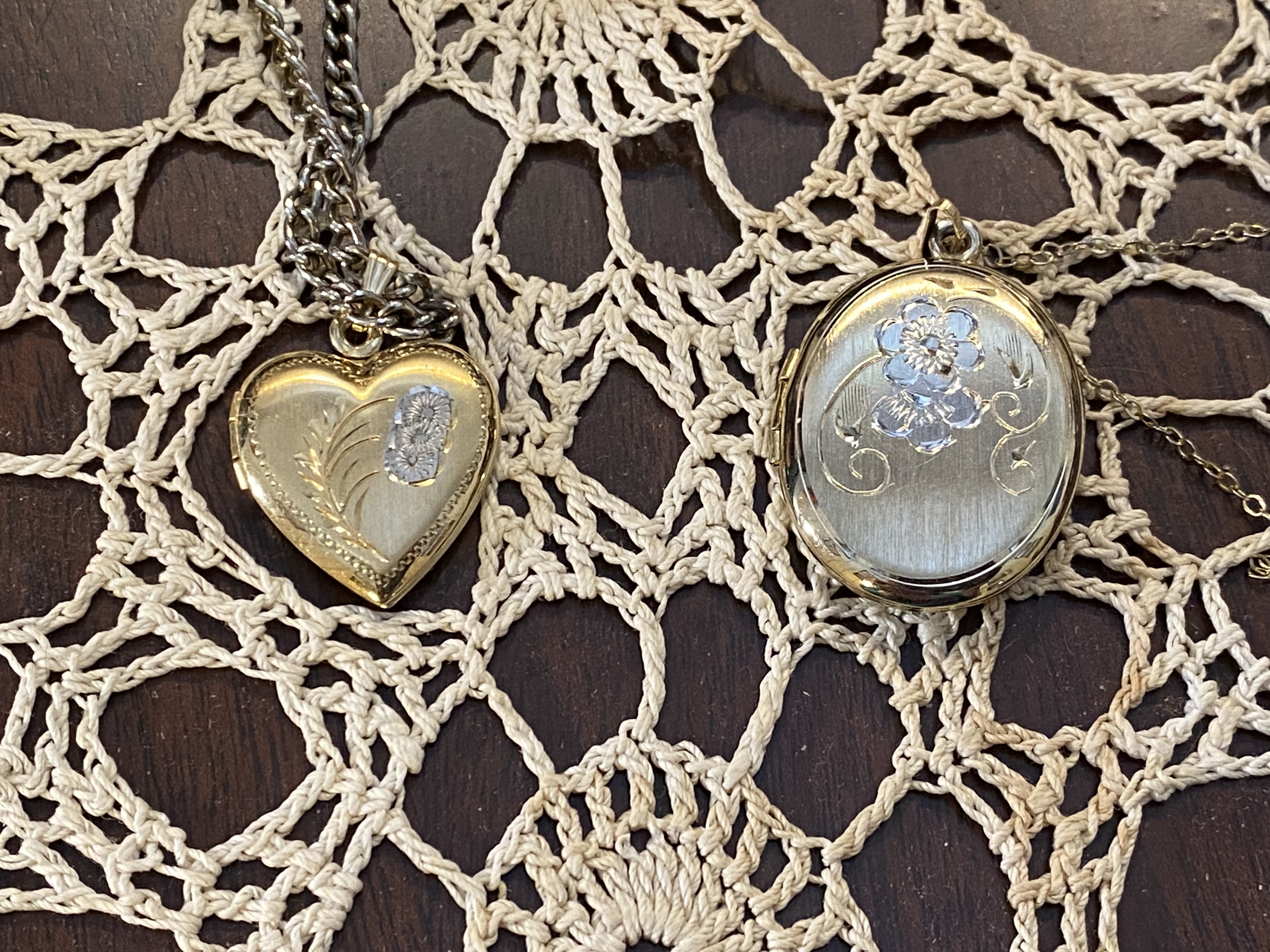
Perhaps some things I did then will help now too. I journaled regularly, poured my soul onto pages in my notebooks. With tiny locks of hair and photos that spoke to me, I made lockets and hung them near my heart. Little by little, I dared to venture forth. I told myself I would make choices and take actions—small at first—but I would do it for the lost children. I would live for those who didn’t have the chance, and I would face each day for the sake of my lost loved ones. I would do my best to make a good life. For them.
I don’t know what lies ahead, though I face it with a certain amount of dread. I can only work with what is here, today, and do my best to make a difference for my family and for as many others as I can.
Do all the good you can,
By all the means you can,
In all the ways you can,
In all the places you can,
At all the times you can,
To all the people you can,
As long as ever you can.
― John Wesley
Last month I attended a few presentations at the Kansas Book Festival in Topeka. The one I remember most was by author and administrator at Haskell Indian Nations University Daniel R. Wildcat. I bought his book, On Indigenuity: Learning the Lessons of Mother Earth, a long essay on what indigenous peoples can teach the rest of us about protecting our miraculous home planet. I have long been concerned about protecting the home we share with all life forms, including people around the world and millions of other species. When greed and lust for power impact the lives of innocents around the world, I am enraged. Destruction of the biosphere that sustains us is now threatened with acceleration. Communities of wild things and minority populations will be the first to feel the impact.
In the early pages of his book, Daniel Wildcat recommended that we should become more familiar with Nature. One thing which compounds and complicates the rampant destruction of our planet is our distance from the elements. We sit inside our comfortable homes in front of screens far too much, and should become more familiar with how the natural world near us is impacted by our decisions and policies. To that end, today I decided I would walk the deer trails on my small patch of virgin tall grass prairie and look for the beauty in Nature. Even if you aren’t close to a 40-acre meadow, you can still take a walk and feel the fresh air and sunshine, listen to whatever birds are in the trees lining the streets, and enjoy the colors of autumn.
These scenes are from my morning walk today.
Sweetgum tree in our front yard, blazing orange.
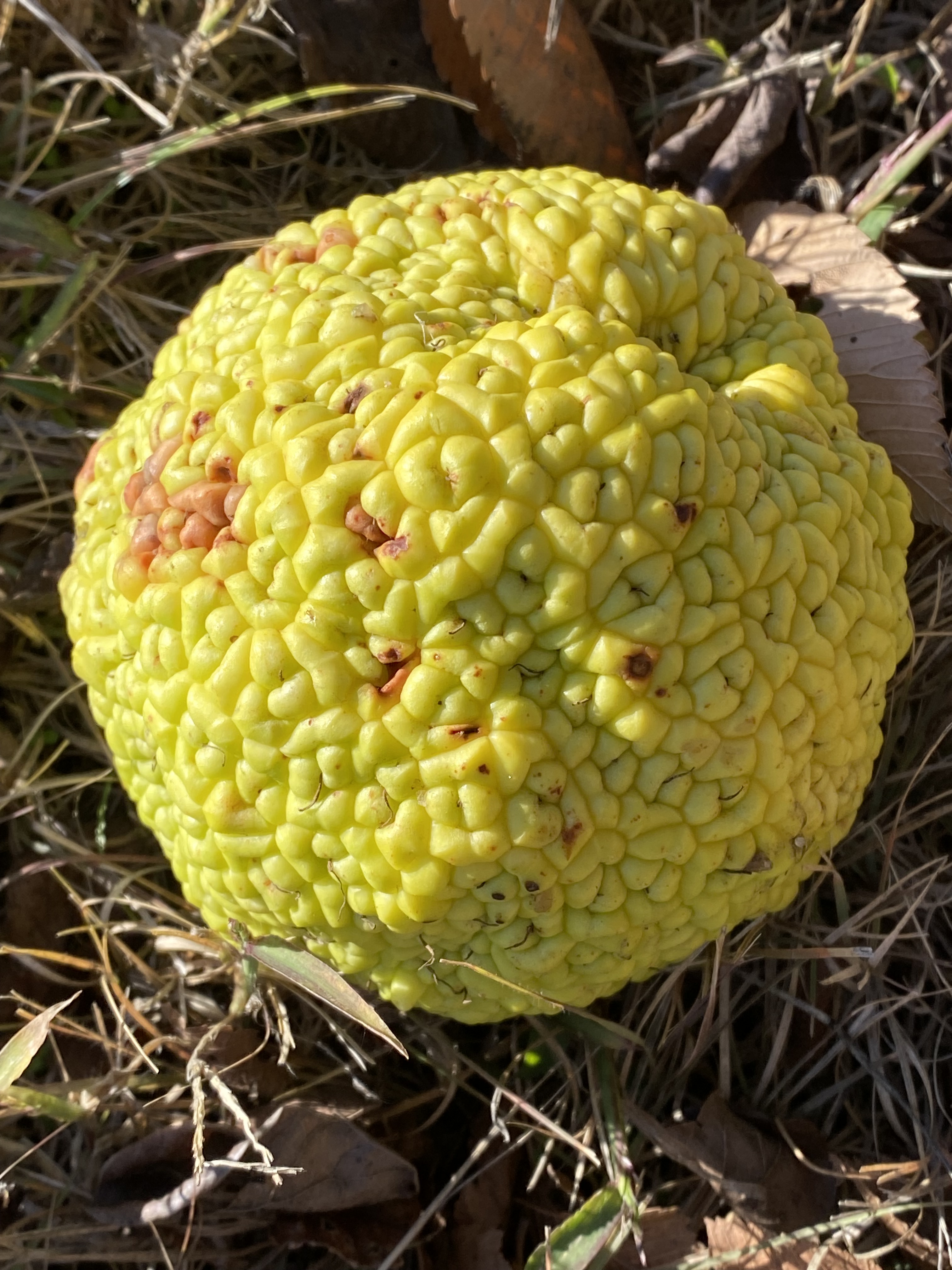
A fallen Osage orange, with closely fitted puzzle-piece segments. No two alike. Just like people.
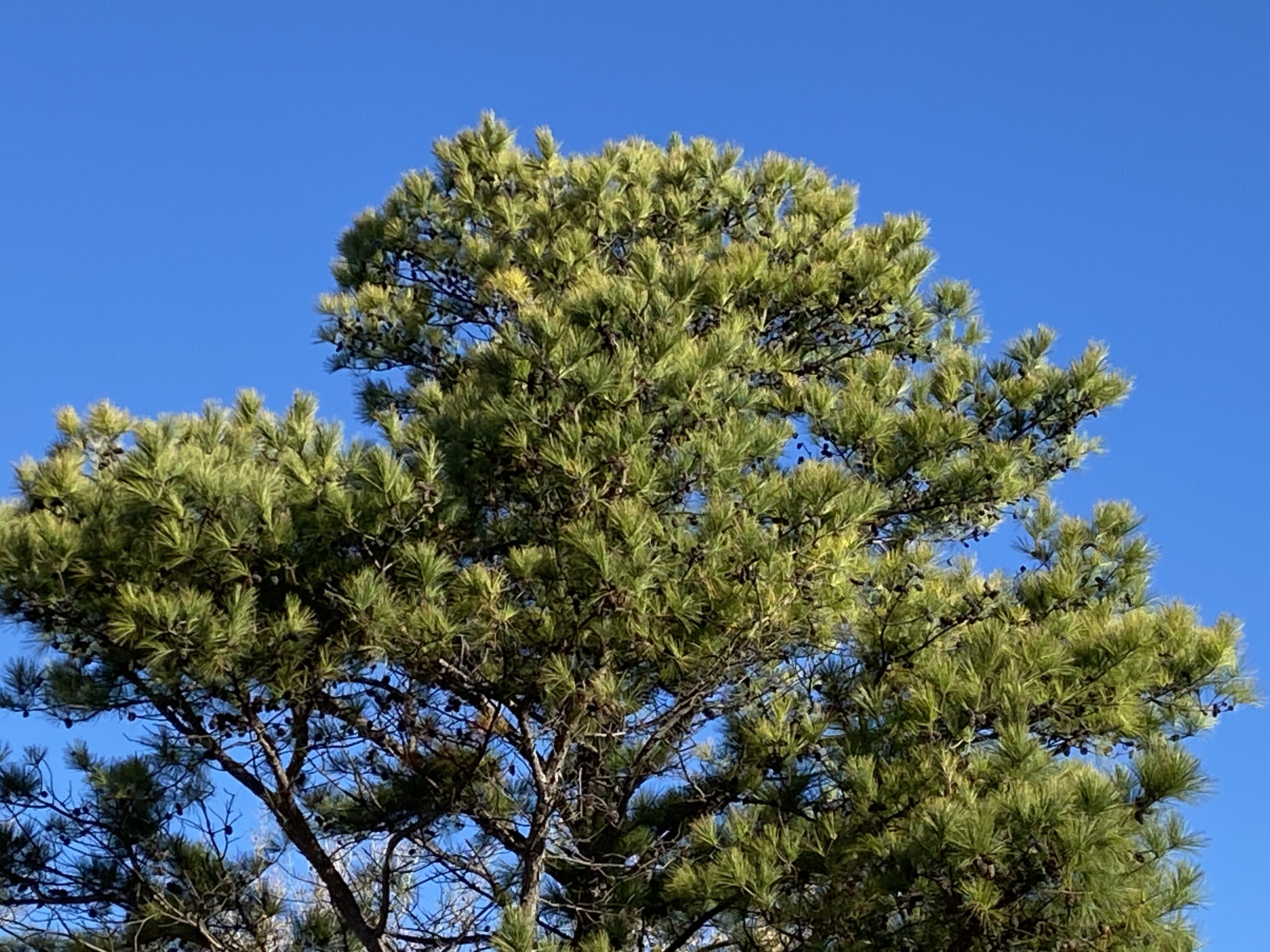
One of the two pine trees on our place, laden with pinecones. I keep wondering when the pine bark beetles will invade, but so far we’ve been lucky.
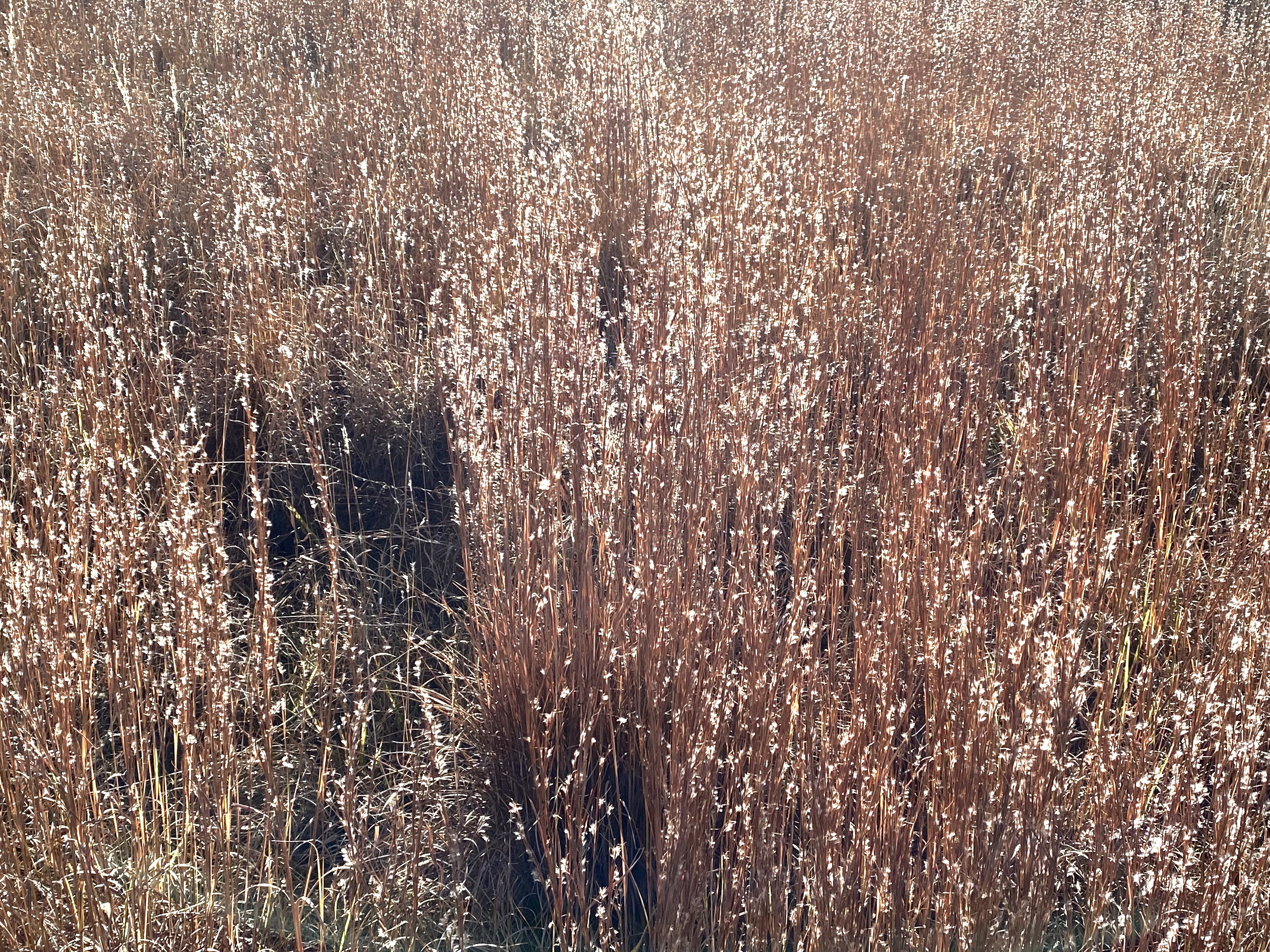
A backlit patch of little bluestem, with fluffs of seeds gleaming like a field of fallen stars.
One of my favorite grasses: Indian grass. The seedheads are still there, though they are far more impressive earlier in the autumn season. This reminds me of Native American writers that I admire, including Daniel Wildcat and Robin Wall Kimmerer. Kimmerer’s book Braiding Sweetgrass changed my life during the Covid shutdown.
Here we are, one week post-election, one week post D-day (diagnosis day for our flailing democracy.) Most of you share the horror and grief I feel after the count, so I’m “preaching to the choir” so to speak. If you happen to be someone who felt smug and victorious after the tally, I don’t know what to say to you. When my nephew was left homeless after a hurricane ravaged his mountain town (Asheville) 400 miles inland, when cousins in southern California find their neighborhood threatened by raging wildfires, when my Cuban friend’s parents near Havana have been without electricity for weeks, I am dumbstruck to realize so many of my countrymen would vote for an aging insurrectionist, convicted felon, rapist, and conman when one of his first orders of business is to increase the drilling and use of fossil fuels.
Are you one who would object, “But wait, I didn’t vote for him!” Yet at the same time, you couldn’t bring yourself to vote for the one candidate who had the best chance to defeat the ugliness and destruction that’s bound to happen. Since my first visit abroad in 1977, I have worked to disprove the myth of the “ugly American.” Yet with this election, you have helped engrave it deeper in the history of the world.
Most of my friends, though, feel as I do. We’re compatriots, we’re family in a broad adoptive sense of the word, and I take comfort from our conversations and correspondence. We need each other to talk to, to share our mutual pain, our disbelief, and our fears. It means a lot to me that we have connected, not only during the weeks before November 5, but in the days since. Bolstering friendships has been one positive thing to come from this heartbreak.
A couple of thoughts about the outcome. I find a smidge of agreement on one of the MAGA points, though the target is polar opposite of theirs. We should beware one certain immigrant from South Africa who just bought a president with his billions.
For those who were all about—“Oh, the New World Order! We can’t have that. Biden has those plans in WRITING!”
Welcome to the New World Order. After the election, Elon Musk crowed on his X account, “Novus ordo seclorum” (Latin for New World Order.) And the written plan? Project 2025, which some have claimed was all lies. They aren’t even trying to deny the project now, and it has been in WRITING the whole time.
For the rest of us who are hurting and grieving over what we’ve lost—a country founded on democratic principles—I will say a few words about grief. We’ve probably all faced loss at some earlier point in our lives. As someone intimately familiar with that deepest of human emotions, I will remind you that you are not alone. Please remember that there is no “right” or “wrong” way to grieve. Allow yourself the privilege to mourn as you are called to, and then join the resistance. I caution you not to blame yourself for the election’s outcome, especially if you did everything you could to prevent the disaster. Try to avoid assigning blame to others, also. There is likely a myriad cluster of circumstances that brought this on us and we will all suffer the consequences together. Some groups will feel it first and worst. We need to support those of our friends who are at greatest risk.
From my own history of loss and recovery, I will offer this: it’s easier in small doses. One day at a time. One hour. Maybe even minute by minute. To that end, I plan to start a thread called, “Just for Today,” in which I’ll share ideas for facing the world and resisting the worst, finding resilience and ways to persevere. If you have ideas to share, let me know.
(See Post #1 Just for Today: I will find something beautiful provided by Nature.)
“This is so sad.” My husband said as he read a post on Facebook.
A former student of his, now working as a nurse in Wichita, had found her soulmate and recently became engaged to a man at the hospital where she worked. He was an EMT on helicopter runs. They excitedly planned a wedding and looked forward to their future together.
Then the helicopter he was on crashed in Oklahoma on a return flight from delivering a patient. Her fiancé, the love of her life, died in that crash. And her world fell apart.
It is sad. My husband looked at me and asked, “Do you think it would help her if we sent your book?”
He was referring to my memoir In the Shadow of the Wind, telling my own story from younger years of a lost love and how I was able to embrace life after the loss. “Someday maybe,” I answered. “This is too fresh for her. The book can be hard to read if your grief is fresh.”
It got me to thinking about grief again. We all experience the devastation of loss at times in our lives. To love someone is to risk heartbreak. One or the other in a loving relationship will someday face that inevitable loss. You just hope it will be years down the road, not tomorrow. But when a tragic accident happens, what can we do to help the survivor?
First, I think, we need to understand that every loss is complex. If no two people are identical, it can also be said that no two losses can be the same either. Nor is there any “proper” way to grieve. Each survivor has to find their own way forward, best done without others suggesting that they need to try a different approach, that their feelings are wrong, or mistaken.
There is no proper way to grieve. What we can do to help is just be there. Offer hugs, if hugs are wanted. Listen to a grieving friend without trying to solve a problem for them. Just listen. Give them a safe place to open their hearts and work through their grief.
It’s easy to understand the emptiness someone feels when they lose a friend, a fiancé, or a spouse. It’s perhaps more difficult to realize the many faces their grief takes on. The young nurse who lost her love already knows that the future they planned is gone. It no longer exists. She grieves for their lost years. Perhaps they talked of children. They too are gone, before they were born, along with all the family holidays and vacations, birthday parties, visits to grandparents, sports outings—everything that might have been is different now. It has changed and cannot be recovered. Each of those burst dreams compounds her feelings of grief.
What this newly bereaved nurse can benefit from are friends who listen as she rails against the universe and cries for her fiancé, and as she bemoans those babes who will never be born, as she lets go of the future they once dreamed together. She needs friends who wrap her in love and compassion and offer hugs to ease heavy arms that ache to hold her soulmate and those babes. She needs friends who travel the path with her as she lets go of a future that has evaporated in a fraction of a second, and give her permission to grieve in a way that works for her, never pushing her to be done with it, but recognizing that her journey is her own.
There is no right or wrong way to travel that road. The upheaval will grow easier with time, but the journey never ends. And each survivor’s path is unique.
So the word is out. There have been millions of babies killed through abortions since the procedure was legalized. I wonder about that. How many of those were fetuses that would never have lived, had they been born? How many procedures were done to save the mother’s life? I have grave reservations about the truth of that statement. Twenty-five million giggly babies just snuffed out? That’s trying to simplify a very complex statistic. After all, in recent years, the objections to terminating a pregnancy have yielded strict limitations on just what kind of pregnancy is eligible.
I am old enough to have come of age during the original fight to legalize abortion. When I was an adolescent, the procedure was illegal. But that didn’t mean abortions didn’t happen. And consequences were severe for desperate women seeking help. Too often, illegal abortions ended up killing or maiming the mother anyway. The legalization of abortion was a life-saving step. Just making it illegal will not stop desperate women from seeking to end a desperate pregnancy.
This all alludes to a sort of class warfare. Did you know, for instance, that 75% of abortions in recent years were for women at or below the federal poverty line? 60% of the women already had children at home that they couldn’t afford to feed. 55% of women who received abortions were single. They had precious little financial help to reach the $196,984 cost of raising a child to age 18. (Yes! Magazine Spring 2022)
It might have been in the early years that the procedure was sought too lightly. But no more. Today, almost all the people I know, pro-choice as well as pro-life, agree that abortion should never be used as a simple form of birth control. We must keep other contraceptives available and affordable and eliminate unwanted pregnancies. Is that a point we all can agree on?
You might find it surprising how many pro-choicers abhor the fact that some women have used abortion as a contraceptive. You might also be surprised how many of us pro-choicers, if offered the choice due to abnormal fetus development, would choose to continue our own pregnancies. After all, if faced with some dire news, you would do that. I would too. But it would be our own choice.
None of us have the right, though, to tell others what they can or can’t do. We simply don’t know all the details.
So has abortion been misused? Sadly, yes, by some. Therefore, you say, we should outlaw all abortions again. It’s just like:
A few people who misuse alcohol and drive drunk. Innocent people have been killed by drunk drivers. Obviously, we’ve banned all alcohol and all cars, right?
Or—A few people misuse guns, and go on shooting rampages, killing children in their school classrooms, and people in shopping centers or theaters or at parades. So of course, we have instituted a national ban on guns, haven’t we?
Oh. . . Wait. . . .
I get it. This is different.
Or is it?
Does mis-use of abortion by a few mean we have to remove that option for all? And if that’s what we gotta do, how about those guns anyway? Surely the right to life, liberty and the pursuit of happiness for school age children is more important than the right to bear arms.
The intrusion into a person’s medical history and privacy is an unconscionable overstep by our government into our private lives and personal rights. None of us has the right to judge another on this extremely personal matter, nor to tell them what to do. We can offer love, compassion, and assistance, but we can’t make difficult choices impossible by removing options. There is nothing simple about pregnancy. Since every case is different, there is no single solution. All options need to be available. And nobody outside the triumvirate of parents and physician should even have a say in tough personal, medical decisions. No two pregnancies are alike. We can’t possibly know the inside stories of other families.
Over the next few days, I will post information about each of the four books I have available. All of them will be part of the Christmasland Event with Writers of the Wheat December 3, 4:00 pm until 9:00, at the Sunflower Plaza in Wichita. Writers of the Wheat is a loosely organized group of Kansas authors who support each other in writing, as well as marketing, their work. Join us at the Sunflower Plaza, 417 East Gilbert in Wichita, December 3. There will be something for every reader’s taste.
Today, I feature my first published book, a memoir titled In the Shadow of the Wind. Though I have aspired to write books as long as I can remember, it was this one that had to come first. It uncorked the bottle of my creativity, so to speak. Released in 2014, I continue to be amazed at the response of new readers. It seems to connect with new folks scattered from coast to coast, and I am humbly grateful to the Winds of the Spirit for making the story known to those who struggle with their own personal grief and need encouragement.
What is it about?
Following a series of tragic losses, at age thirty I found myself in a strange world, anticipating a lonely future. Widowed, and grieving the loss of two infants, I retreated to the wilderness for comfort and healing. Planning to stay forty days, I set up a solitary camp on the Neosho River bank of my family’s abandoned farm homestead. Marooned by rising flood water after only a few days, I had to face my own mortality.
I discovered that there is life after loss. Through a sequence of extraordinary events, In the Shadow of the Wind tells my story: how an ordinary woman learned to dance on the threshold of fear, to cherish every moment of life, and to believe in my inner resources to conquer adversity.
Prologue from the Book
“It’s okay, Daisy Pup,” I said. The small spaniel whined. I drew her to my chest and we cuddled together. Thunder exploded in the air above our little tent. The after-rumbles faded. Seconds later rain pelted the nylon roof of my fair-weather shelter. Daisy shivered in my arms. “It’ll be okay.” I tried to convince myself.
I felt foolish. How could I have thought this was a good idea? How could I have dreamed that I would be able to withstand forty days in the wilderness? The rain turned my plan into a futile effort that bordered on the edge of insanity.
A drop of water stabbed my forehead. In the gray afternoon light, I saw hundreds of droplets hang heavily from the inside of the tent roof. The threat of a cold shower hovered inches away.
“Good Lord, Daisy—it’s going to rain inside the tent.”
There was no escape from the chill in the air. No escape from the fingers of cold that crept up from below. No escape from—“Oh, my God, the sleeping bag is wet.”
I shifted sideways in the orange tent and discovered we huddled in a growing pool of water, now about an inch deep. “Oh, God, this is crazy.”
My canine companion stood and shook.
“You need to go out?”
She wagged her stubby tail and shook again. I unzipped the door and she jumped into the deluge. I grabbed my boots and began to pull one over a damp sock. On second thought, I tied the laces together, removed my socks, and backed out of the low-slung tent. I pulled my backpack into the soggy afternoon, zipped the tent door shut, and stood barefoot in black ooze.
Daisy splashed through standing water. She located a slight rise, squatted, and relieved herself. I glanced at the sodden landscape. Water stood everywhere, and I was already soaked in the downpour. What were we to do? I turned in a circle and searched for shelter. An old wooden railroad boxcar, the only structure that remained on the abandoned farm, stood right behind the tent.
I stooped to look under the boxcar. We could wiggle under it. I quickly discarded that idea. The prospect of lying in muck was no better than sitting in a wet tent. Padlocks secured the sliding doors of the boxcar. Even if I had a key, I doubted I could budge them enough to allow entrance. The aged wooden sides looked weathered and soft. One ragged gap at the leading edge of the north door panel appeared almost large enough for me to wiggle inside.
I slogged to the side of the boxcar and grasped the lower edge of one ragged slat. I tugged on the worn end. With my entire weight behind my efforts, I ripped off inches at a time until the opening had grown twice as large.
“Come here, Daisy. Let’s check this out.” She was instantly at my mud-covered heels. I patted the dark floor of the boxcar, standing forty inches off the ground. Daisy leaped. With an assist from me, she scrambled into the dark interior. I stuffed my backpack behind her, slogged to the tent and pulled my boots and the bedding into the storm. I struggled to maintain balance as I slipped back to the hole in the door and crammed the bundle of blankets inside. Then I leaned into the darkness of the abandoned car and jumped. On my stomach, legs dangling out the opening, I snaked forward a few inches. With flailing arms, I reached into the darkness in search of something to grab.
There. Something metallic. Perhaps an old piece of farm equipment. I didn’t know. I could see very little. But it didn’t budge, so I was able to pull myself into the relatively dry interior of the old boxcar. Across the car, Daisy snuffled and sneezed a couple times. I stood and felt my way around the area. After locating a pile of old shingles along the south wall, I propped the backpack on the floor beside them. I shook the damp bedding. My clothing was soaked through, so I wrapped the blankets and sleeping bag around my shoulders. I sat on the shingles and leaned against the wall of the boxcar.
Daisy bounded onto my lap. We shared each other’s warmth as the deluge continued outside. Moments after we both settled down, I heard scratching noises inside the boxcar. Light-footed creatures scampered about the interior. I hugged Daisy a little tighter. I could see pinpoints of light here and there, small eyes that reflected the afternoon light filtering in through holes in the wall. Oh, my God.
Rats. Lots of them.
I screamed. “I am such a fool, Daisy. Why do you put up with me?”
She licked my chin.
I spoke to my late husband Craig. “What am I going to do? I don’t think I can do this. I can’t live without you.”
He, of course, didn’t answer. I was on my own.
Daisy whined softly and licked my chin as if she understood. The storm mirrored the anguish in my heart. The entire universe wept with me. “What are we going to do, girl? I don’t know where we’re heading. I only know where we’ve been.”
When I met Craig, we thought we had all the time in the world. A decade was hard to visualize. Had we known that all our joys, our plans, and dreams, would have to be packed into one decade, would we have spent our days differently? Would our choices have been laced with more love and wisdom, or with desperate lunacy? Based on the law of averages, we had every reason to expect several decades together.
Yet there was barely one.
“It’s not fair! It’s not fair!” I railed against the universe.
Since I was young, I found peace and unconditional acceptance in the natural world, even in difficult times. Especially in difficult times. During a traumatic adolescence, I surrounded myself with nature in my hideaway room at home. There was a fifty-gallon aquarium, and shelves in the windows filled with houseplants. Some even vined across the ceiling. My own private forest.
In Nature, I found evidence of a supreme being beyond what our senses show. Through countless moments filled with awe and wonder at the mystery of life, of connections with other beings, I grew to love the Earth, its life, and its mysteries. As we approach a precipice of no-return in the global crisis brought on by our industrial and consumer-oriented lifestyle, I feel great sadness, along with deep gratitude for the gift of life itself, and for all the moments when I sense the Beyond through simple contacts with other living things. Climate grief is a true thing.
I wonder what awe-filled moments do you recall that you wish your grandchildren—and theirs—could experience?
Have you ever . . .
Watched an eagle soar and listened to its distant call?
Sat on a trailside boulder and watched an aspen seed float to the ground?
Had a hummingbird check your red bandanna for nectar?
Watched a glacier calve an iceberg?
Heard a rush of wings in the stillness of a heavy mist?
Watched a loggerheaded shrike hang a field mouse on a locust thorn?
Risen before dawn to visit booming grounds of lesser prairie chickens?
Watched a lone prairie dog scamper away from its village into the sunset?
Surprised a family of deer on a winter walk?
Watched a flock of robins sip melting snow from your house gutters?
Walked with a flashlight after dark in September to watch orb spiders at work?
Witnessed a black bear check out the milo fields on the high plains of Kansas?
Heard the scream of a cougar outside your tent in the middle of the night?
Watched autumn leaves dance with hundreds of migrating monarch butterflies at dusk?
Held a newly metamorphosed moth in your hand and watched its virgin flight?
Heard barking sea lions as they congregated on the shore below the seaside cliff where you stood?
Through six decades, travels from Oregon and California to Maryland and Florida, Minnesota to Arizona, as well as journeys to Japan, India, Hawaii, Canada, Alaska, Cuba, and Mexico—not to mention my own backyard—the wonderments of Earth have held me spellbound in every little nook. With deep gratitude for all I have been fortunate to witness, and with fervent hope that we can stop our catapult into disaster at COP26, I offer Part 2 of the slide show from my younger days. Let humanity not be responsible for the Omega curtain on our gem of a planet.
Music: Beethoven’s Symphony No. 9 in D minor, “Chorale Symphony.”
A pioneer story of Kansas by Mabel Chandler Harris.
Part IV
George Chandler, his son Gene, and the horse Ned went doggedly forward and when the man felt sleepy in spite of himself, he knew he must act. He stopped the horse and slid out of the saddle. He could hardly support himself and clung to the stirrup. The horse dropped his head to the snow and snorted furry icicles from his nostrils. The man pulled the chilled boy into the saddle and carefully wrapped the blanket about his cold feet and legs. He removed the long wool scarf from his own neck and wound it round and round the head and shoulders of his son. He slapped his hands against his chest and stomped up and down until he felt renewed circulation of blood in his veins and his feet did not feel so much like frozen lumps.
When he felt somewhat restored, he gave Ned a slap on the rump and grasped the stirrup firmly. They proceeded on their way. The wind remained bitter and fierce. The cold grew more intense. George thought it must be after midnight. He was sure they were still several miles from home.
He gave himself up to thought. He believed in prayer and he had to have some help right now. He asked God for strength and endurance. He prayed for the son in the saddle and for the precious daughter who had been so faithful during these months when he had been forced to be away from home. As he prayed, he was strengthened. He felt reassured that they would reach home.
Gene seemed to be sleep on the horse. George’s thoughts drifted. He remembered himself as a mere lad in the Army of the Republic. He recalled the joyful day he married Hannah Priscilla Crabtree. He remembered the home life in Missouri and the glowing reports of cheap land in Kansas. These reports had fired both his and his wife’s imagination, so he had purchased their present home from a local land agent whom he had trusted implicitly. They had loaded their belongings in the two big wagons. With the crated chickens fastened underneath the wagon beds, and the boys driving the cows and extra horses, they came west from Kansas City on the great trail.
The Chandlers reached their destination in northern Lyon County, Kansas a week later. No one would ever know his bitter disappointment when he had first seen the treeless, poor upland farm that he had bargained for. He had not known there was so much pasture in all the world. He had dreamed of a farm in the bend of a creek, but the creek turned out to be a gully that passed through his land as a raging torrent after a big rain, a dry slough the remainder of the time.
The horse dragged on. George staggered as he clung to Ned. His arms ached. With thoughts of the family that waited for him, he poured his last ounce of determination into his efforts. He resolutely lifted one foot after the other, glad that Gene was quiet.
The night was clearing enough that he recognized the little cemetery in the whiteness. Ned must have come this far west to avoid some very deep snow drifts. The horse was doing fine to know so much even it if did make the way a mile longer.
Thoughts continued like a rushing stream that would not be stopped. The Chandlers had worked at making a home on that upland claim. And then—oh dear God—there had been Delphia, the blue baby. Disconnected scraps of memories filled his laboring mind. “Dust to dust. Ashes to ashes.” Preachers always said those words in burial services.
With cold misgivings he asked himself, “Is there more than that in life?” Hannah was taken when he had needed her so badly. Was she better off than he this terrible night? The harrowing experience of moving little Delphia’s body from the corner to the place at the head of her mother haunted him. It was noon on a warm May day when the little disinterred coffin rested on the green grass. His helpers stood around while he obeyed an impulse to open the lid to peek at his darling child again. In the first instant as they all looked the baby form was there in its original angelic beauty. With the impact of warm air, the little form crumbled into a tiny mound of ashes.
Shuddering, George forced his mind back to his present surroundings. “I must be awfully cold to let myself think in this way,” he thought. “I will not doubt. The word says the spirit shall return to God who gave it. God help me,” he prayed, “to be able to say, even tonight, The Lord hath given and the Lord hath taken away.” Aloud he said, “Blessed be the name of the Lord. I know that God giveth His children strength.”
At his voice, Gene mumbled “What did you say, Pa?”
The father answered, “We will get home. We are almost there.”
It was about three o’clock in the morning when the horse stopped at the stone house. The man gave a shout and dragged the nearly frozen boy from the saddle. The door flew open and Henry, followed by the tall neighbor boy, rushed out and half carried them into light and warmth. Charlie, the lame boy, limped away with old Ned, and while the people in the house worked over the man and the boy, restoring them with a tub of snow, Charlie fed and rubbed the animal that had brought his father and brother home safely home.
When only partially recovered from his night’s experience, the man whose sandy hair had turned white during the last twelve hours, turned to the bedside of his sick daughter.
As he stroked her hair, she spoke her last words, “I knew you would come, Pa.”
The father, with spasms of pain crossing and re-crossing his fine face, held the hand that so confidently had been placed in his. He realized his efforts to save this beloved daughter had been in vain.
As dawn broke over the windswept hillside, Etta Viola Chandler died. George gathered as many of his children as he could clasp into his arms. They clung to him or to each other as he bowed his head in submission and whispered so all could hear, “Thy will be done.”
That was the morning of January 19, 1882. The place was a quarter of a mile south of the original Santa Fe Trail that wended its way across northern Lyon County, Kansas. The Old Santa Fe Trail was the way thousands of people followed west in the 1800s. With their heads, hearts, and hands they literally created a democracy the likes of which is not found anywhere else on our earth.
Because of the bitter cold, Etta Viola Chandler, seventeen-and-a-half years of age, could not be buried in the little Bushong Cemetery beside her mother until January 24, 1882.
The End
Notes about Mabel Chandler Harris, the author of this historical narrative, and the setting of the story.
Mabel was born to George Chandler and his second wife, Carrie, in 1890. She was one of eight children of this second marriage. The children in her “High Courage” story were mostly grown when Mabel was a child, but she must have heard this family story and her heart went out to their struggles.
Mabel married Loren Scott Harris, the older brother of my grandfather Charley Harris, on June 7, 1915. They had one child, Florence Ethel, born December 22, 1927, who was a favorite cousin of my father, Wallace. He called Florence by the nickname Pete.
Pete moved to Wichita during her adult years and shared this “High Courage” story with her dear friend and tax accountant. When Wallace moved to Cowley County from Lyon County, he also hired Pete’s accountant friend to handle his taxes, and I followed suit. During one of my annual tax meetings, she presented me with a copy of Mabel’s story about the blizzard of 1882.
Loren and Mabel lived in Dunlap, Kansas, just up the road from the Harris family homestead on the Neosho River where my grandfather and father lived. Mabel had the distinguished honor to become the first woman to be ordained as a minister of the Methodist Church in the entire state of Kansas. She performed wedding ceremonies, and funerals, for many rural folks, including the Harris family.
The settler’s town named in the story, Bushong, Kansas, is today little more than a few neighborly homes on the paved county road due north of Americus, Kansas. To put more perspective on the horseback journey of Gene and his father on Ned the trusty horse, Bushong is a good 20 miles from the heart of Emporia. The stone cabin where Etta waited would have been even further. Gene and Ned traveled more than 40 miles in that storm, 20 of them on the return trip with George, in the dark, facing into the wind. That blows my mind. Teenage Gene indeed showed great courage, as well as a deep love for his sister and the rest of the family.


 Grandma told me that she had received this begonia from her mother, who got it from her mother, and so on and so forth. It is a living family heirloom. The cuttings keep going over many generations, and decades, and multiple centuries. Who is to know how old this plant really is? For Grandma, it dated back to the 1800s. It’s now part of my 21st century garden.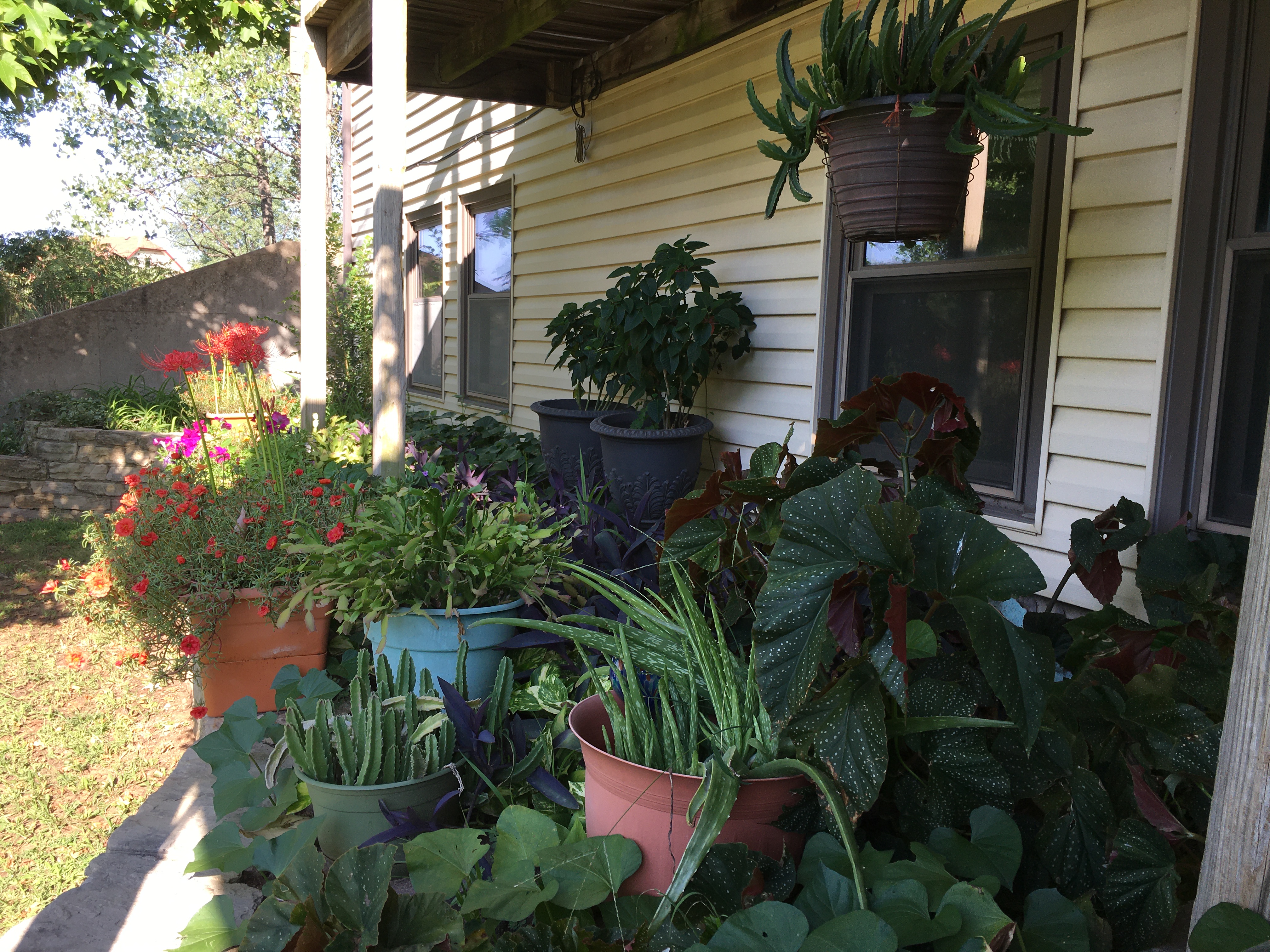














 The Bridge