
Recently, I ordered a book that was reviewed in a post by Jess Piper, author of the substack “View from Rural Missouri.” The book, Dear Marty, We Crapped in Our Nest, was written by Art Cullen, editor of the Storm Lake Times in rural Iowa, and published by Ice Cube Press.
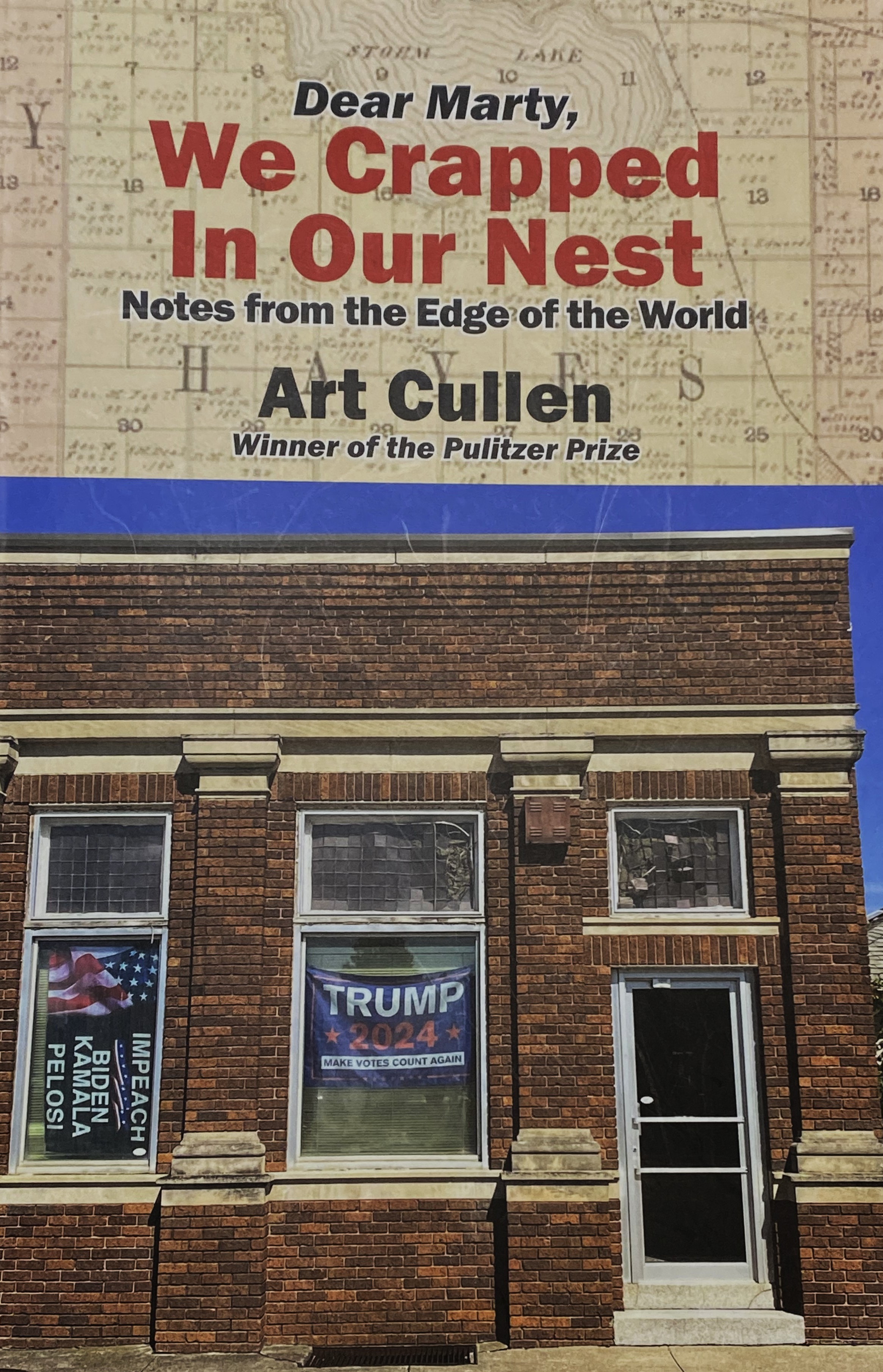
Cullen was awarded the Pulitzer Prize for Editorial Writing in 2017 for his series on agricultural surface water pollution in Iowa. Rural Missouri, rural Iowa, and rural Kansas have many common concerns. Cullen’s hometown of Storm Lake, Iowa with its newspaper is very much like our hometowns in Cowley County. His subtitle calls the content “Notes from the Edge of the World.” Given that much of it is pertinent across the entire plains region, it seems more like Notes from the Heart of America.
Much of Cullen’s 2025 book covered topics we are familiar with here, like the decline of our rural communities, the “Brain Drain” exodus of our young people to the cities, and the effect of Big Ag policies on family farmers. Cullen wrote about the exploitation of the deep, rich Iowa soils from what the indigenous Ioway people knew for thousands of years, to the devastation of the last few decades with much of the soil washed down the rivers to the Gulf of Mexico. The surface waters that people and livestock depend on became contaminated with as much as 40% of the chemicals Big Ag prescribed as necessary soil additives. That came with a hidden price tag. Iowa is the #1 state in the union for cancer statistics, largely attributable to the surface water pollutants.
Cullen referred to Aldo Leopold’s Sand County Almanac in one chapter. Leopold promoted harmony between humans and the land they depend on. He demanded a more ethical approach to land use, like the one practiced by indigenous peoples for thousands of years, now overshadowed by the desire for cash income. But, land is a community, not a commodity. Leopold said that the oldest task in human history is to live on a piece of land without spoiling it. We are failing that task miserably.
Cullen’s final chapter offers hope and a way forward. We have withstood many challenges in the 250-year history of our democracy, he wrote. “What the Republic cannot endure, and which gives enemies of freedom oxygen, is the contempt that has taken hold American-to-American.”
We need to talk to each other, Cullen said. But how? That question, he says, will be answered in spaces like ours, the small towns and rural places of America, “where you have to get along even when you want to spit at each other.”
The first step is to try to look through your neighbor’s glasses. We may just find out that we all want pretty much the same things: clean air and water, safe schools, good food, smooth roads, friendly neighborhoods, easy access to comprehensive and affordable health care, and the ability to prosper.
Cullen: “There is a way forward if we will only talk to each other earnestly. We know how to fix things. The Earth can heal if we let it. . . We can break up the oligopolies that choke independence, diversity, and rural vitality. . . We can learn from the [indigenous] people to live with the land in abundance if we choose not to attempt dominion over Nature. . . We can choose prosperity for agriculture through science and good sense.
“We have little choice but to change the practices of the last half century before we burn ourselves up.”















 The Bridge