Dear Tanna,
Considering the power of love, scattered on the Wind of the Spirit, there was John Lewis, another hero who passed from this life on July 17 this past summer. All the publicity since George Floyd’s murder in late May–the demonstrations against police violence, Black Lives Matter, racism, and white privilege–bring social inequities front and center. With each successive generation, the wounds re-open. We were all reminded of John Lewis’s struggle to grant basic civil rights to all American citizens when he died. Our local library selected his memoir as part of the adult summer reading selection. With a Zoom meeting planned that included Lewis’s co-author Michael D’Orso, a man Lewis claimed was like a brother to him in the book’s introduction, I wanted to participate.
The book itself was daunting, 503 pages of relatively small print. But the metaphor in the prologue hooked me, a description of a wind storm Lewis experienced as a preschool boy. The wind blew so strong it lifted a corner of the shack his sharecropper aunt and uncle lived in. Harboring in the shack with his aunt and fifteen cousins, they held hands and walked from corner to corner, bringing the house down to the ground when the wind began to lift it. That became the metaphor for his life, and provided the title for his book, Walking With the Wind: A Memoir of the Movement.
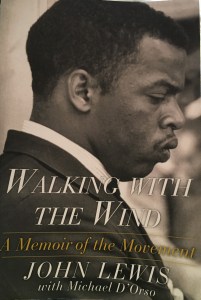
Lewis was a teenager by the time I showed up in the world. I remember the events of the civil rights struggle of the early 60s as a child overhearing her parents discuss the nightly news. It was not until I read this book almost six decades later that I fully realized what had occurred during those years.
The chapters in the memoir flowed, easy to read. It was like sitting with John Lewis over coffee and listening to him tell about his life. And what a life! He personally knew the key players. John F. Kennedy, Bobby Kennedy, Martin Luther King, Jr.
He told of the first time he heard MLK give a sermon on the radio. It was titled, “Paul’s Letter to American Christians.”
Wouldn’t it be cool, I thought, to read King’s words? An online search for his sermons produced a website—www.kinginstitute.stanford.edu—that includes his entire collection of sermons. So I did read “Paul’s Letter to American Christians,” in the year 2020.
Lewis was a key figure in all the civil rights actions: the restaurant sit-ins, freedom rides, marches, Selma’s Bloody Sunday, the efforts to safely register black people as voters. His premise was aligned with Ghandi and Nelson Mandela, a non-violent protest. Love your neighbor, even those who beat on you.
Why? We may ask.
Because they are victims of this unjust system too.
Imagine the strength of character needed to love someone who was busting your head open with a wooden club. How could a person manage that? Lewis shared one of his secrets. You imagine the oppressor as an infant, a precious child of God.
I was struck by the uncanny parallels to today’s social and political climate. Lewis, a genuine and unassuming man, shared lessons he’d learned from MLK. “People who hunger for fame don’t realize that if they’re in the spotlight today, somebody else will be tomorrow. Fame never lasts. The work you do, the things you accomplish—that’s what endures. That’s what really means something.”
Does this remind me of anyone in the spotlight today? Absolutely.
What rights are guaranteed by the Civil Rights Act of the late 60s? 1) The right to vote. 2) The right to a fair trial. 3) The right to receive government services. 4) The right to use public facilities. and 5) The right to a public education.
Sounds pretty basic to me, but for ages, a significant portion of our population was denied these rights. After the legislation, new practices skirting the edges effectively denied the same people basic human dignities others take for granted.
Has this changed in the 200 years separating you and me, Tanna? I desperately hope so. I hope that your generation experiences the blessings of Martin Luther King’s Beloved Community. Lewis never lost sight of the vision—one people, one family, one house, one nation. As a congressman from Georgia for the last years of his life, he answered to his conscience and worked toward policies that would benefit all people.
The last chapter in his memoir was a summary and a wish. “Onward” described the challenges he faced during the time when he wrote the book—1998—but it could well have been written during this last summer of 2020. The struggle for civil rights, for civility itself to be extended to all citizens in our country, indeed to all of the world’s inhabitants, seems never to end. Each generation must carry on and must learn and appreciate the sacrifices and struggles of the generations before. Slowly we may approach an equitable society, a new global economy that values not only human players, but the finite resources provided by our planet.
John Lewis devoted his entire life to a movement he firmly believed continued decades beyond the demonstrations of the 1960s. “I came to Congress with a legacy to uphold, with a commitment to carry on the spirit, the goals and the principles of nonviolence, social action, and a truly interracial democracy.
“We must realize that we are all in this together,” he said. “Not as black or white, Not as rich or poor. Not even as Americans or ‘non’ Americans. But as human beings. . .The next frontier for America lies in the direction of our spiritual strength as a community. . . It is not just materially or militarily that we must measure our might, but morally. . .”
“It does not profit a nation to gain the world if we must lose our soul—which includes our compassion. . . ”
“The alternative to reaching out is to allow the gaps between us to grow, and this is something we simply cannot afford to do. . . ”
“That sense of caring and sharing that makes us a society and not just a collection of isolated individuals living behind locked doors must never be lost, or it will be the end of us as a nation. . .”
I wonder, Septanna, how healthy is the nation in your day? How healthy is the planet?
John Lewis, a great man, concluded his final chapter with these words, “Talk is fine. Discussion is fine. But we must respond. We must act . . . As a nation, we must move our feet, our hands, our hearts, our resources to build and not to tear down, to reconcile and not to divide, to love and not to hate, to heal and not to kill. In the final analysis, we are one people, one family, one house. . .”
Tanna, this is what’s at stake even now, two decades after Lewis published his memoir. This has been a hard chapter for me to write. I have struggled with it for weeks. How do I, an ordinary grandmother living in conservative rural Kansas, attempt to share what this man’s life has planted in my own heart? It’s too important not to try, though. So I offer these thoughts in honor of John Lewis. I desperately hope that he and other notable leaders we lost during the last few months—George Floyd, Breonna Taylor, Ruth Bader Ginsburg,—will lend their essences to our continuing struggle for securing human dignity and basic rights for all.
And, Tanna, I hope that, two hundred years from now, you will realize the results of our efforts.
With enduring hope and love,
Your seventh-generation grandmother


 His memoir, Walking with the Wind, starts with this story from his childhood. He was with his siblings and cousins, about 15 children total, playing at his aunt’s simple house in Alabama. A storm blew up, and they ran into the house. The small frame building began to sway in the wind. “Wood plank flooring beneath us began to bend. And then, a corner of the room started lifting up. . . The storm was actually pulling the house toward the sky. With us inside it.”


 The Bridge