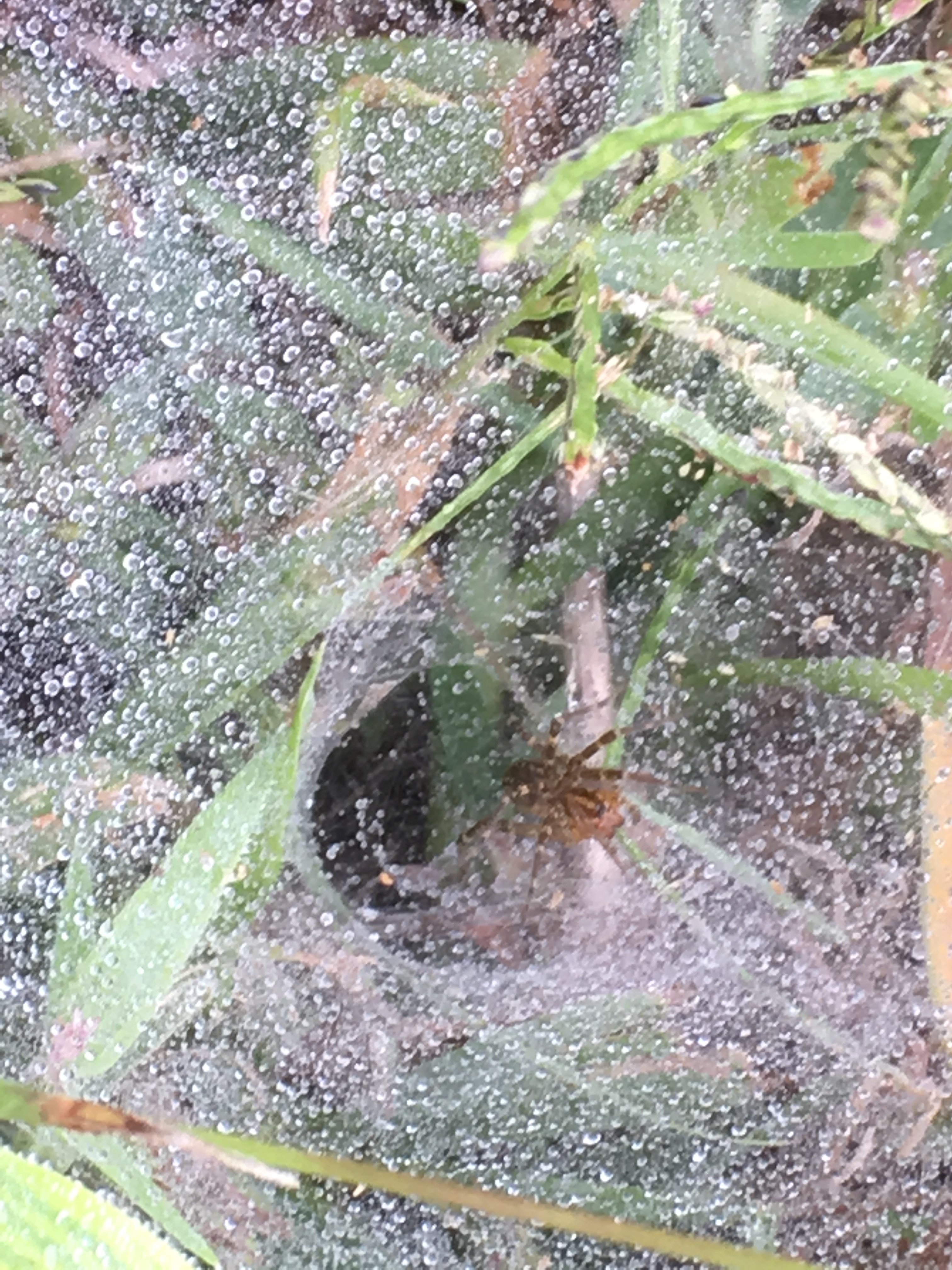
What is Quality Life?

“It’s a discovery of your inner landscape when you turn something over and over in your mind until suddenly you see it from a new viewpoint. It involves insight, and is illuminating, sometimes beautiful.”

“The thinker, the writer, the feeler experiences life itself as his best learning tree.”

“A quality life involves awareness, simplicity, magnanimity, and independence.”

-Marvin Swanson

I recently stumbled across a few words from a piano technician I regard highly. We tend to go from “simplicity to complexity to perplexity to harmony,” a poetic sequence of words describing many of life’s quests.


Refreshing our Awareness

Marvin was forever seeking “fresh awarenesses of the long-familiar”, as well as ideas on how to accomplish that. Here’s a list:

“How can we work to heighten awareness? (1) a change in our routine; (2) taking time to analyze; (3) writing, painting, photographing, actually performing in the arts; (4) a new view of the familiar. How do you achieve this?

How can we make the familiar stand out in freshness and newness? It often seems to take a change from the ordinary—a change of feelings, of routine, of environment or a change of season.”

-Marvin Swanson

A Definition of Love


“Love is affection that endures and enriches in spite of differences. The differences between two people, even the difficulties, help with the enriching too . . . if they work to overcome the latter.”

– Marvin Swanson

For this week celebrating love between spouses, between partners, among friends, and with family members, I share Marvin’s definition of love.

Embracing our Ancestors

I was not lucky enough to meet either of my grandfathers, but my grandmothers were very important to me. Marvin belonged to the same generation as my parents, so when he wrote about his grandfather, that was the generation prior to my own grandparents. The late 1800s was a time far too early to fret about human enterprise actually changing the whole biosphere (if that was even a word then) and causing mass extinctions. Trying to visualize life in those days is a fascinating exercise of the imagination.

From Marvin:

“I found a letter my grandfather wrote to my grandmother from New York City in 1888. He was going to medical school. She and their children lived in Randolph, Kansas, a small town completely obliterated by Tuttle Creek Dam. I thought how real and concrete their world seemed to them—as though it would never change—horses and buggies, no nuclear age. Once my grandfather told me he had lived in a golden age. He filled his clay pot with service to others. . . and I played within the boundaries of his smile.

“Our world is a dream world too, as theirs, wisping away, changing, reforming with new descendants. How can we best fill our clay pots? We know our clay fragments can’t be destroyed as molecules but what of us? Is there anything more important than adding another link to dream worlds?”

-Marvin Swanson


On the Power of Love

Love abides, though sometimes it goes into hibernation. Then the sound of a voice, a memory, an object, a passage from a book wakens it, and you know it has been there all the time. Sometimes a crisis awakens it. Sometimes standing on a peak of suffering before a cliff, it not only awakens but overwhelms you. It is the kind of love that transcends the love of a person for a person and embraces all.

-Marvin Swanson

The Legacy of Marvin Swanson

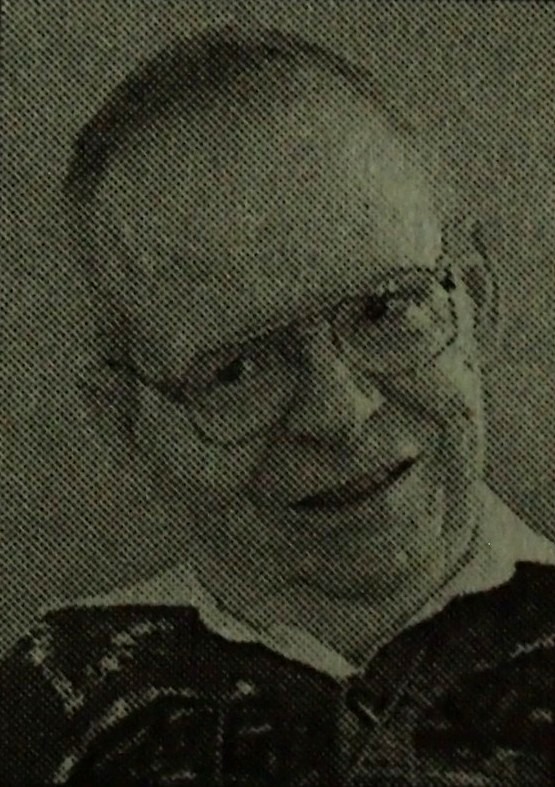
When Covid rudely interrupted life for most of us, my series of Swanson quotations took a long break. This year I plan to return to sharing some special words left to me by my good friend, writing coach, and life mentor, Marvin Swanson. Though Marvin has been gone nearly 25 years, for me his memory lives on, as well as important lessons shared through the collection of letters he sent me.

Born in western Kansas in 1923, Marvin became afflicted with debilitating arthritis when yet a teenager. For over thirty years, he was an instructor of writing at Fort Hays State University and the University of Kansas, through correspondence courses. Living close to the campus of FHSU, he rented rooms to students and served as a mentor and a kind of foster-parent to those who shared his walls.

Marvin was a founding member of the Western Kansas Association on Concerns of the Disabled. The founding principle, possibly penned by Marvin himself, reads:

We, the members of the Western Kansas Association on Concerns of the Disabled, believe that all disabled persons, regardless of their disability, have the right to choose their own lifestyle. Along with this right comes responsibility. Therefore, we also believe that all disabled persons, no matter the degree of disability, can and should contribute something to society. We have dedicated ourselves and WKACD to the continuation of these principles.”

If contributions could be measured, those of Marvin Edgerton Swanson would rank among the highest humanity has to offer. Though imprisoned in a body wracked with pain, he transcended that condition. His mind, ever observant and quick to compile subtle nuances into gems of wisdom, connected with people of all ages to contribute to the betterment of life for all.

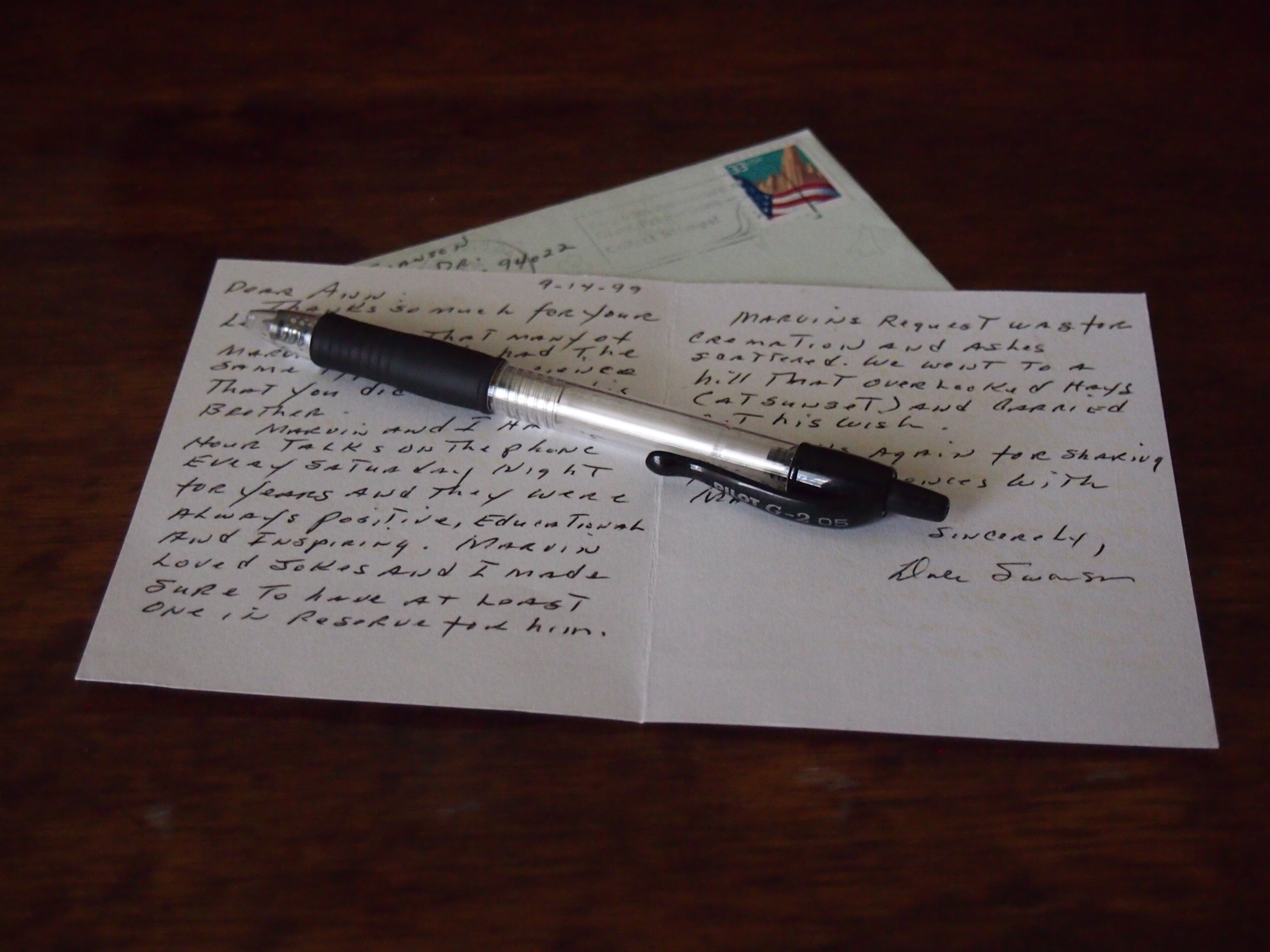
I met Marvin when I attended college at FHSU. We corresponded regularly until shortly before his death. His arthritis compromised his ability to wield a pen so he learned to polish the thoughts he inked onto his monogrammed stationery before writing them down. His letters were deeply well-planned in order to wring the deepest meaning from each word. When I read them again, he comes to life in my mind. The years drop away and it is almost as if I am young again, curled on his sofa, relating my thoughts to him in exchange for his ageless wisdom. Over the coming months, I plan to feature gems of Marvin’s wisdom gleaned from his letters.

Today’s gem reviews one I shared a few years ago, appropriately a few thoughts about letters.

I’ve been working on an article about the dwindling act of writing personal letters. Up to 80% of our reduced 1st class mail consists of business letters. Will the personal letter exchange gradually disappear in the electronic communication revolution? The personal letter has many unique advantages.

            Ellen Terry, an actress, began writing to George Bernard Shaw when they were both single. They never met. Both married. They wrote for 25 years. Shaw wrote about their correspondence, which has been published: “Let those who complain that it (the Shaw-Ellen Terry “romantic correspondence”)was all on paper remember that only on paper has humanity yet achieved glory, beauty, truth, knowledge, virtue, and abiding love.”

            Imagine, I can read a letter Christopher Columbus wrote describing America or Edgar Allen Poe’s letter revealing the secret of the real tragedy of his life. They’re in a book with many more entitled The World’s Great Letters.  I have it.

            “Letters . . . are, of all the words of men, in my judgment, the best.” (Francis Bacon)


A New Chapter

Earl Nightingale said the hardest job you can tackle is thinking a thought through to its end. That’s what writing is. You get an idea and not only have to think it through but revise it many times to make it more effective.”

— Marvin Swanson

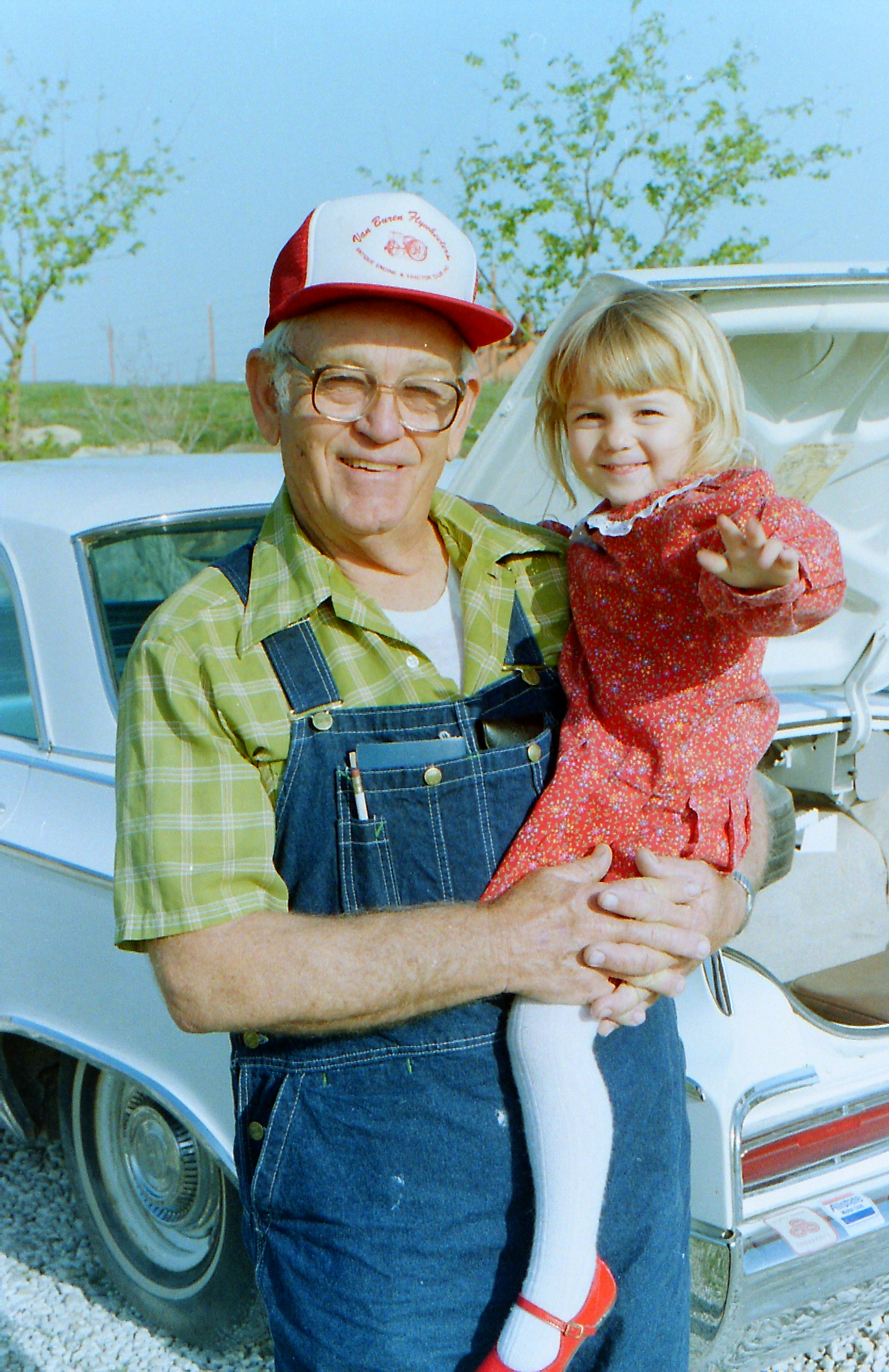
This morning I headed to the college in Arkansas City to prepare pianos for the spring semester. My mind was drawn to the day I worked at that same task one decade ago. While busy twisting tuning pins, getting the fleet of pianos tuned up after the dry winter air soured them, my phone rang. It was the hospital in Winfield. My dad had arrived and was having “a little heart attack.” To this day, I cannot fathom why the medical person called it “little.” They had decided he should go to the Heart Hospital in Wichita. Do I need to drive him there, I asked. No, she said, we will send him in an ambulance.

Thirty-six hours later, after a procedure in Wichita, after  my sister from northern Kansas arrived, after a lengthy visit or two in his hospital room, laughing and remembering, and saying “I love you,” after a last phone message recorded on my answering machine while I was en route home, (“Please bring my walking stick next time you come up. Don’t make a special trip.”), another heart attack took his life. It was January 13, 2010.

We were called back to the hospital late at night by a nurse who didn’t think he’d make it through this one. This was the Heart Hospital. She ought to know. Kay and I dressed hurriedly and rushed back, fretting through a cantankerous stop light that refused us a green, running it red, racing to the parking lot and dashing in, only to learn he had just passed.

And so, in that moment, the role of grizzled and wise family elder passed to my sisters and me. We were orphans.

That was ten years ago. I marvel at what he and my mother missed in those ten years. Though I miss them more than ever, life goes on. Things my dad missed include weddings of several of his grandchildren, and break-ups of others, births of my three grandchildren, as well as several of my sister’s, watching them grow,remodeling our house—complete with geothermal heat pump, solar panels, and wind turbine,


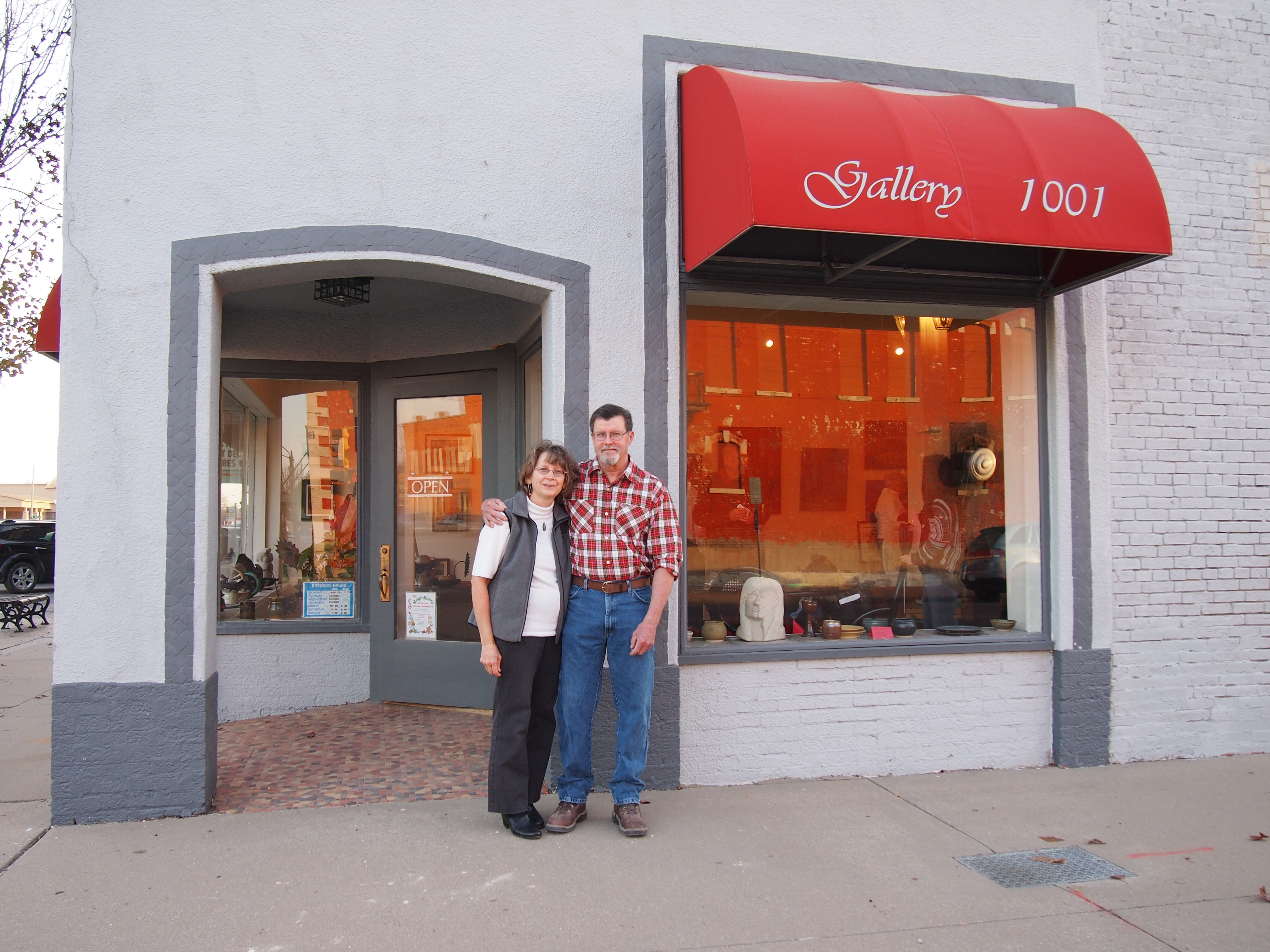
remodeling a building in downtown Winfield into an art gallery,

friendships renewed, new friends made, international travel opportunities, heartaches and joys, hopes, dreams, and disappointments.

Life goes on.

I also marvel at the way my dad’s death opened a new chapter in my avocation. He was a master at new chapters. And he taught me well. When you face inescapable changes in life, it is far better to embrace them and turn a corner to new adventures than to wring your hands in despair. Losing my dad reminded me that you can’t take life for granted. If there’s something your heart urges you to do, do it. Conversations and events in the days following his exit convinced me to return to writing, an ambition from my early years. It was time to finish a book I’d started 28 years previously. I’d put it aside to raise a family, and to get beyond the emotional upheaval of those times. For ten years now, I have risen early to put pen to paper. And I have finished three books in those ten years.

In the Shadow of the Wind went to press in 2014. Two years later I finished Sundrop Sonata, a novel of suspense started in my wild imaginings 12 years previously during the summer following my mother’s death.

And as I write this today, Sonata of Elsie Lenore, a sequel to Sundrop Sonata, is ready to upload to the printer. It should be accessible by February 9.

Book #3 has been an adventure of another kind, taking me to Cuba ten months ago, bringing new friends into my life and bolstering old friendships. (More about this in future posts.)

Three books in ten years. I think my dad would be pleased.

With his career thriving and a baby on the way, life looks good to Stefano Valdez, a Cuban classical pianist. Then a postcard from the past shatters his world. Days before the expected birth, he heads south to find the author of the card, a sister he long believed to be dead. Trailing her to Cuba, he unwittingly places his Kansas family in the sights of the crime ring that destroyed his sister. Will he discover the hidden message in her hastily-penned words in time to save his family?

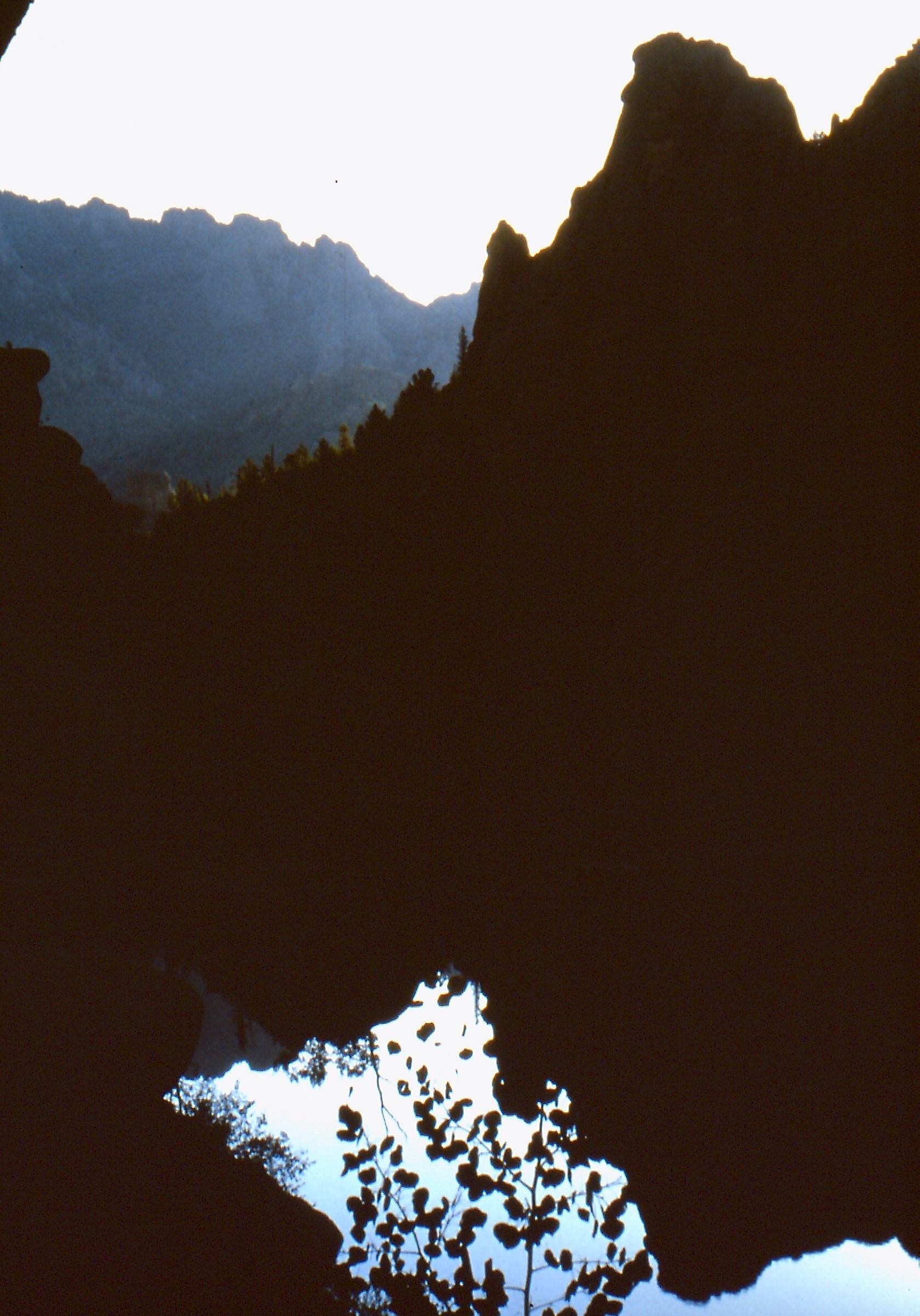
Awakenings

For the last few weeks, I’ve contemplated the question raised by Marvin Swanson decades ago. What things do hamper our awareness of our immediate surroundings? Things that distract our minds, keep us focused on inner dialogue, perhaps. Though he noted several young friends who were television addicts forty years ago, I suspect Marvin would be amazed to find that today we can take our screen distractions to any place at any time and ignore what’s happening in front of us.


From Marvin:

I’ve been thinking of what puts blinders on awareness: feeling down, worry, being an eccentric wheel around an unproductive crush, too much alcohol or drugs.

And what increases awareness? How can one develop greater awareness? It often seems to take a change from the ordinary—a change of feelings, of routine, of environment. How can we make the familiar stand out in freshness and newness? Go outdoors. Enjoy stimulating conversation with a new acquaintance. Read a good book. Listen to music. Sometimes a good TV show or movie works. A change of season helps too.

Awareness is increased by (1) change (2) time to analyze experience. Can we add more to our list?

MS

What have I missed by being self-absorbed? How can I break out of that box?

What works for you?