Hiroshima. . .Then

A month ago, we walked through the museum and around the grounds of the Hiroshima Peace Park in Japan. That was before the inauguration of a dangerous leader in the US who seems oblivious to lessons of the past. Over the last month, I have struggled with a search for the most appropriate words to describe our experience in Hiroshima, as humbling as it was awe-inspiring, and as terrifying as it was motivating. Our entire trip to Japan for a visit to our US military family, was in the shadow of ominous historical events that predate my years, but which my parents lived through and knew intimately.

dsc02677
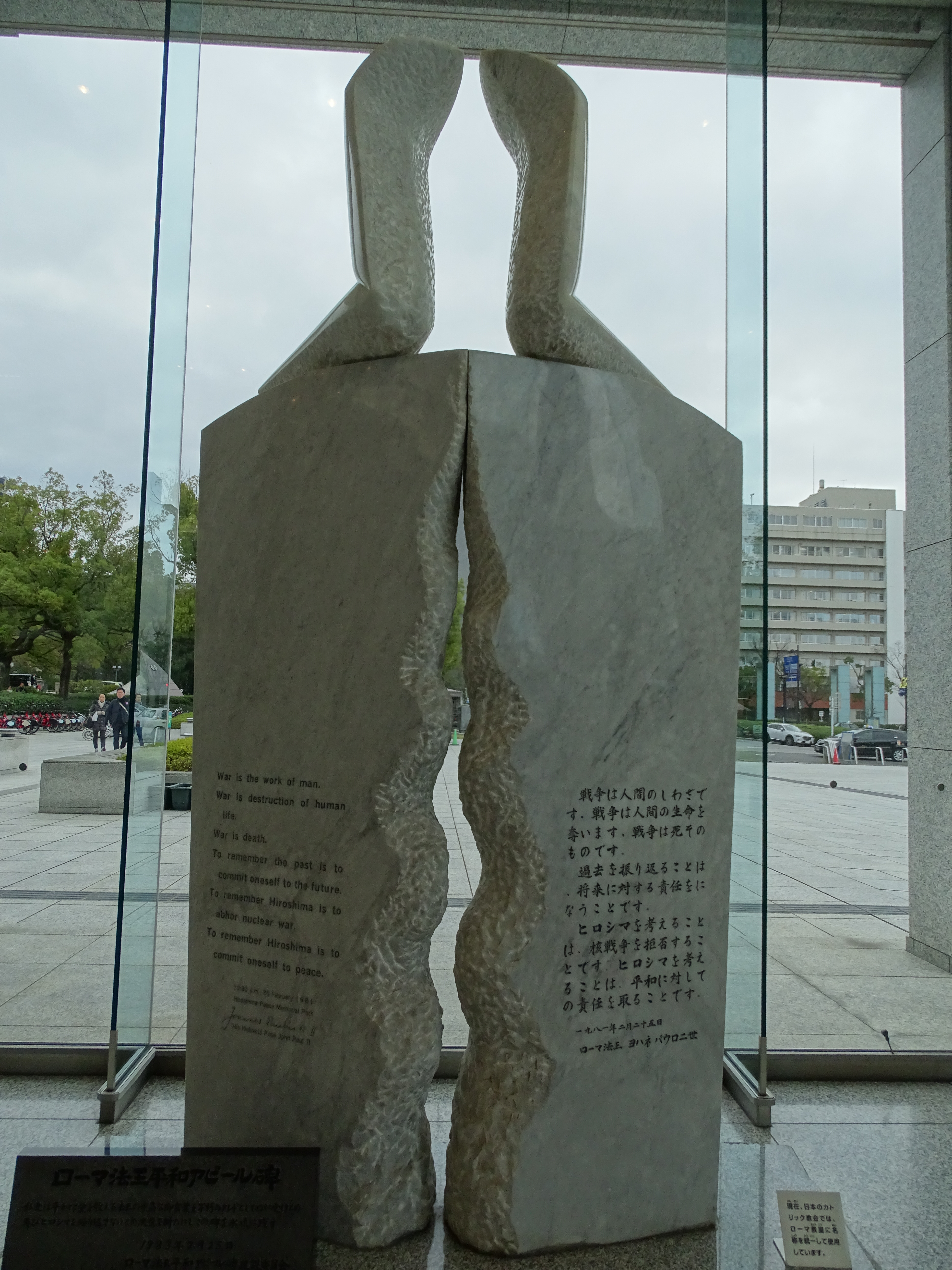
Peace Museum, 2017. English message on left. Japanese message on right.


“To remember Hiroshima is to commit oneself to peace,” as Pope John Paul said on the 25th of February in 1981.

Peace. . . A condition marked by freedom from oppression, harmony in relationships, and agreement to end hostilities, a definition according to my desk dictionary. It is also a condition that is perhaps as far removed from reality today as it was 75 years ago.

news-headlines-pearl-harbor

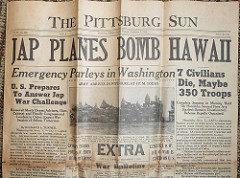
The US was drawn into active participation in World War II after Japan bombed Navy ships at Pearl Harbor, Hawaii.

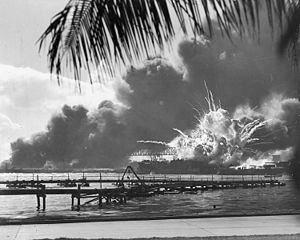
300px-uss_shaw_exploding_pearl_harbor_nara_80-g-16871_2
USS Shaw exploding in Pearl Harbor.

My uncle Lester, the older brother of my father, was in his third month of training for service with the US Navy at the time of the Pearl Harbor attack. He hastily jotted a note of reassurance to his family, and sent it home via air mail. Not to worry, he wrote, he was all right. However things were likely to change given the course of events, and his Christmas leave was likely to be cancelled.

It was. Lester made it home for one last visit the following summer before losing his life, almost a year to the day after Pearl Harbor. The big war impacted my own family in ways we still feel after 75 years, as surely as it left an impact on countless other American, European, Russian, and Japanese people.

Hiroshima before August 1945

About 3 ½ years after the attack at Pearl Harbor, and many battles later, The US took the fight onto Japanese soil.

dsc03387

With the horrific bombing of Hiroshima on August 6, 1945, and Nagasaki a week later, the war ended. The Japanese people had changed forever.

Hiroshima before the bomb

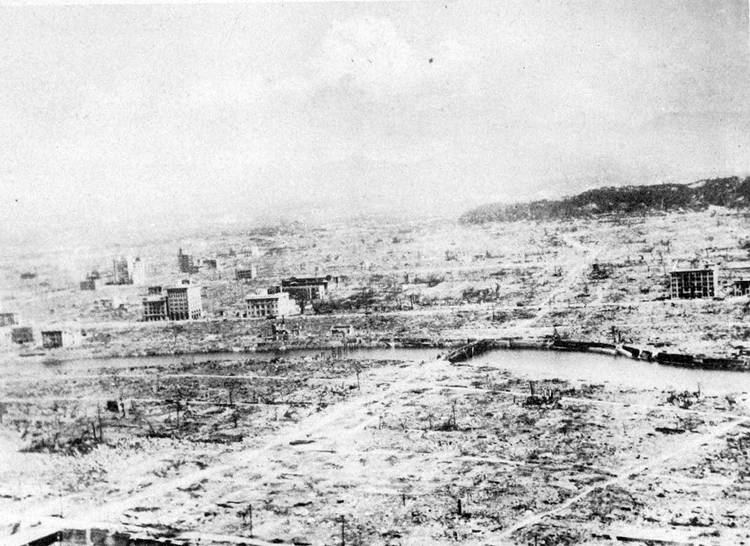
At 8:15 in the morning, as civilians scurried to their daily work, school children settled into their first class, and businesses opened for shoppers, the world’s first atomic bomb was unleashed in the air 600 meters above downtown Hiroshima. In an instant, the city lay in smoldering ruins.

HIroshima after the bomb
Hiroshima after the bomb

An estimated 200,000 people perished. Most were civilians, including the school children. A number of US prisoners of war and Korean natives working in Hiroshima also were lost.

After the bomb
After the bomb
Aftermath of the bomb
Destruction
Destruction

2b24774e00000578-3186815-devastated_hardly_any_buildings_in_hiroshima_were_left_standing_-a-96_1438857513539

hiroshima-bomb-result-3

hiroshima28
This unique t-shaped bridge is reported to have been the target of the A-bomb. It was still standing after the blast, and could be used, as seen here.

The detonation of the atomic bomb over a bridge in Hiroshima triggered the end of the war and was heralded with great celebration in this country. It was only later, after the destruction became apparent, that we realized what had been unleashed in Japan.

Washington Post edition with news of the bomb
Washington Post edition with news of the bomb, August 7, 1945
dsc03385
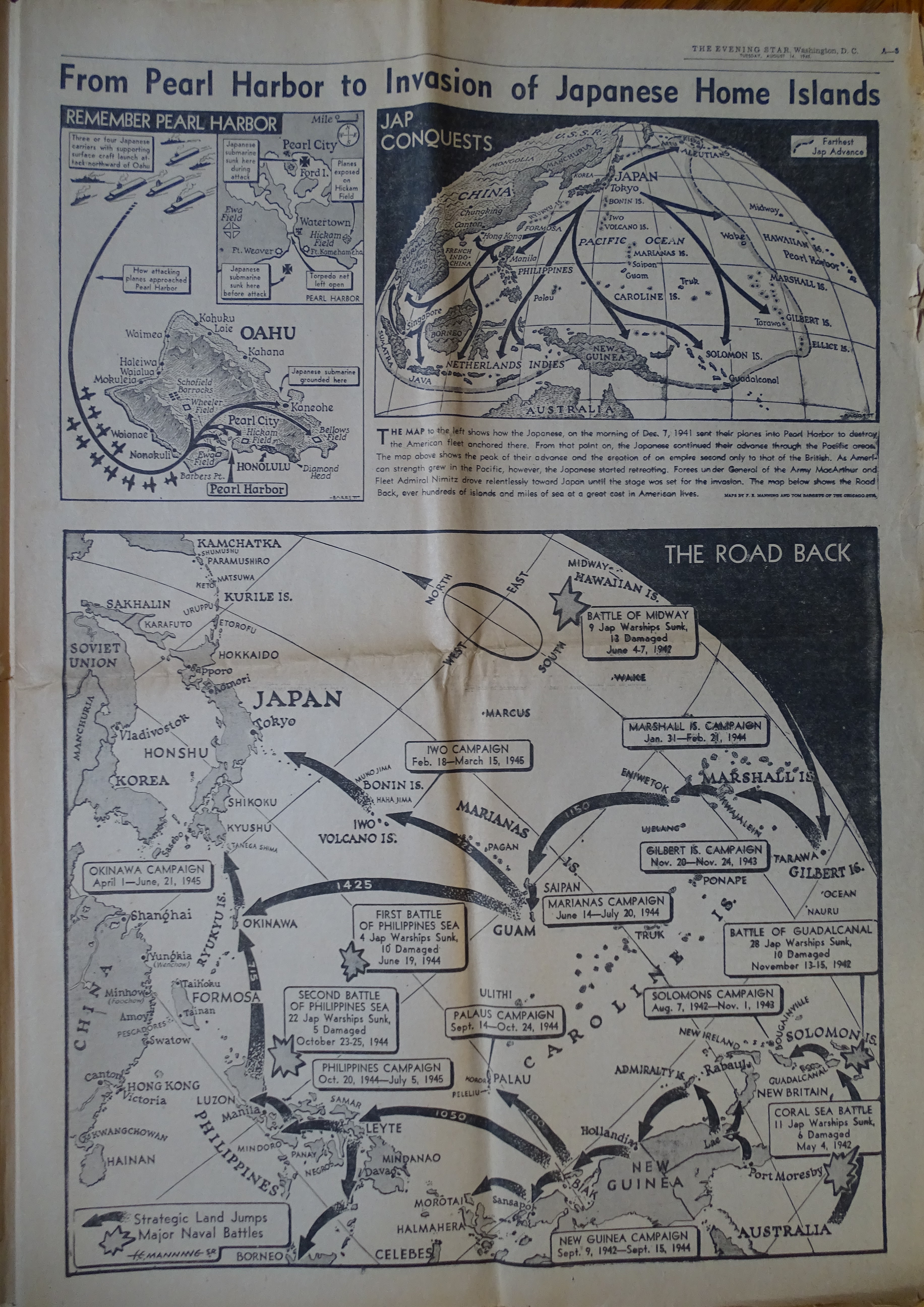
The Evening Star, Washington DC August 14, 1945

Seven decades later, Hiroshima is again a bustling, modern city, undistinguished from many other cities around the world, except for its World Heritage site, commemorating the bomb and a pledge to world peace that this kind of destruction will never happen again.

from a museum sculpture


Next:

Hiroshima. . .Now


We Pawns Speak

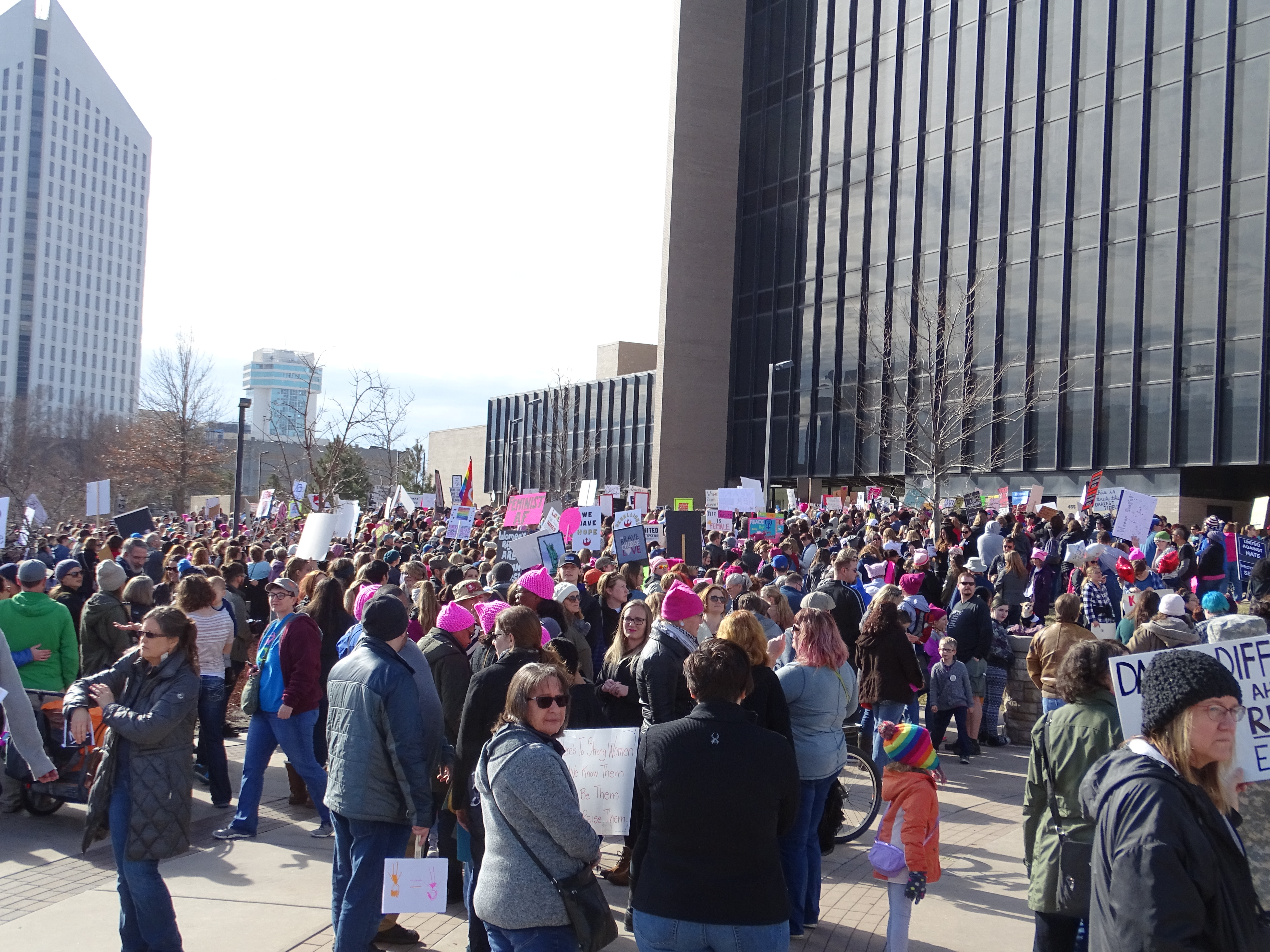
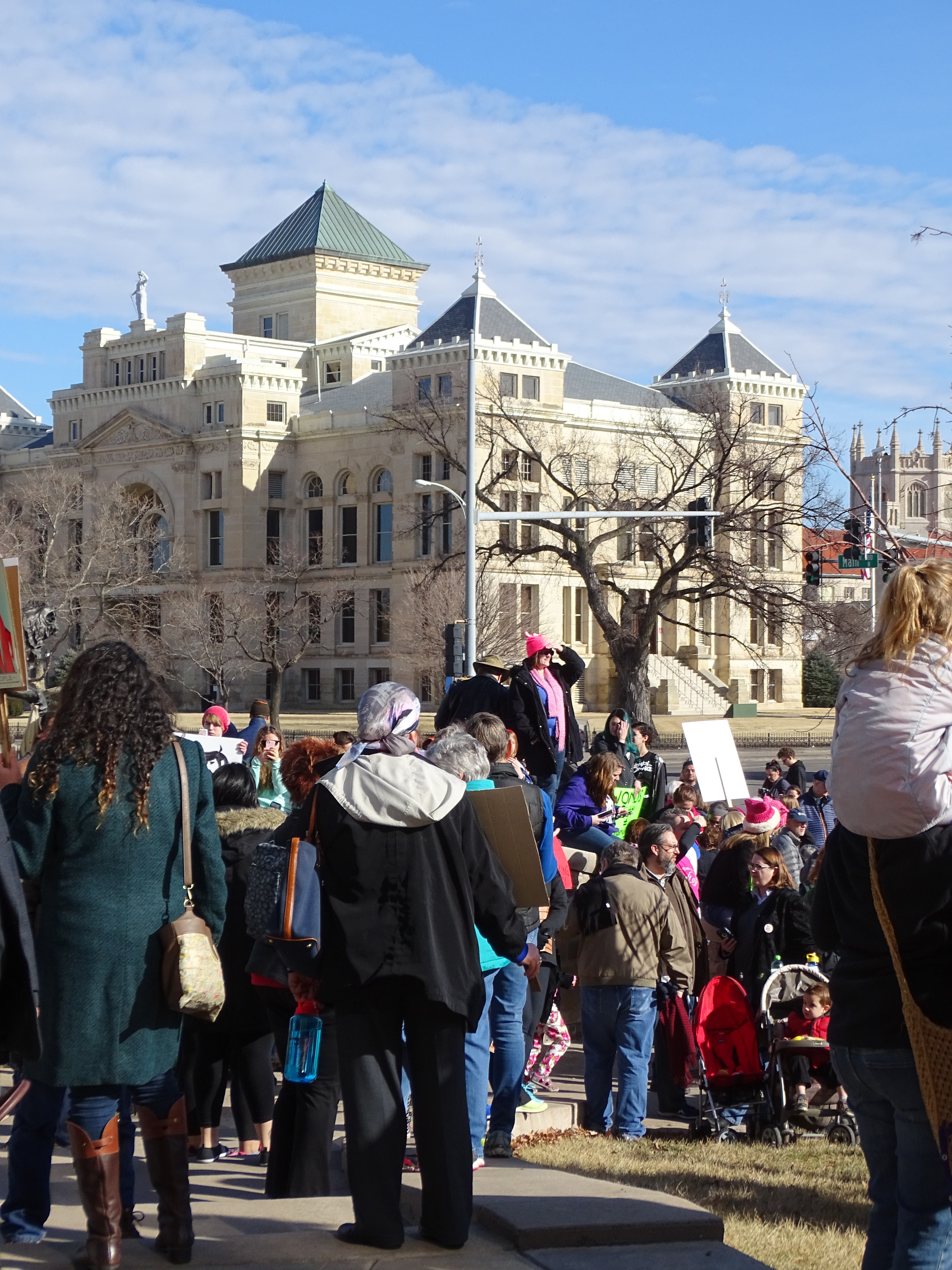
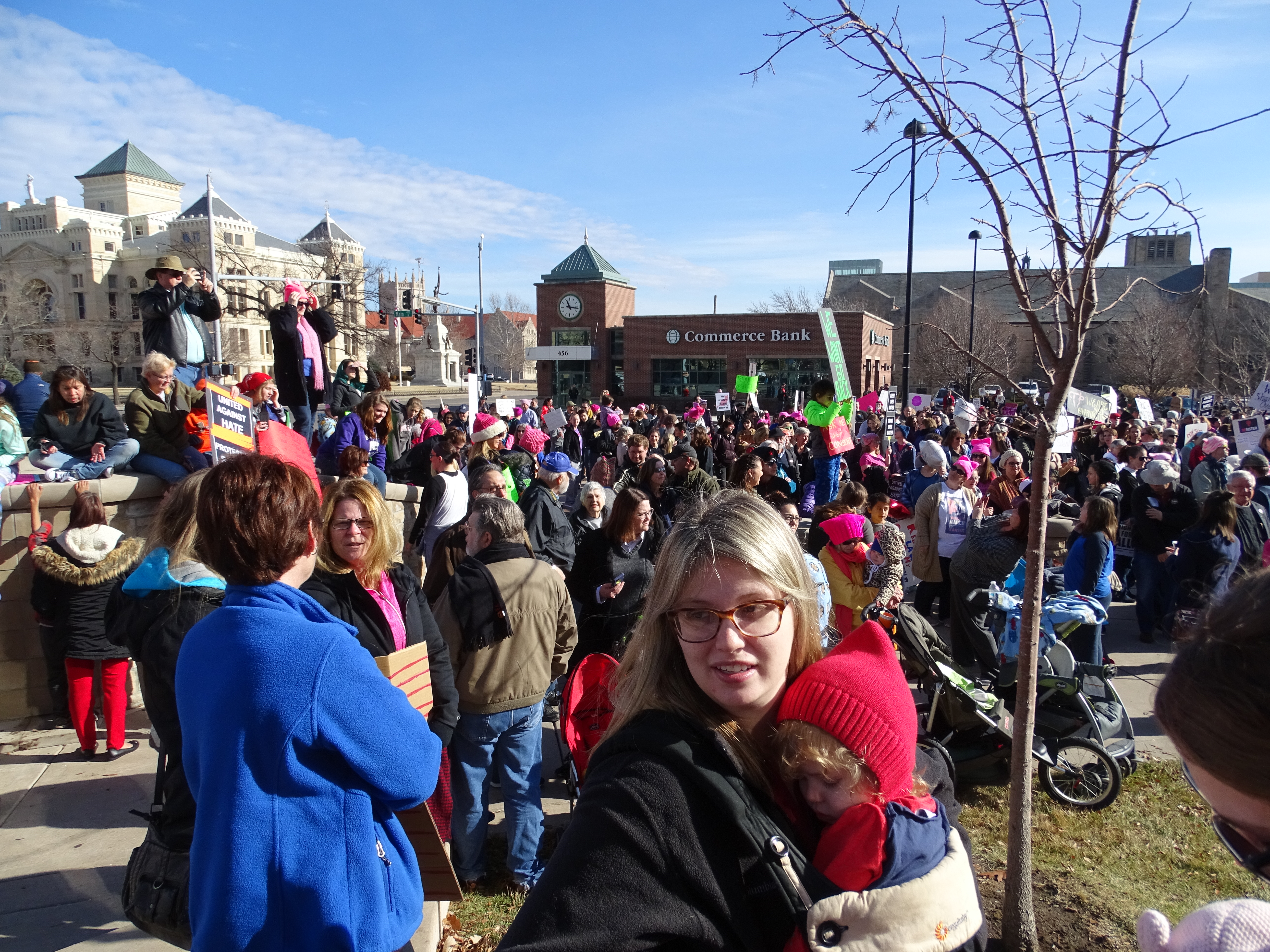
If the Sister March in Wichita, Kansas was representative of other events in solidarity with the Women’s March in DC, there is a good start to peaceful resistance around the world. The sun warmed the morning, pink hats dotted the crowd like so much party confetti scattered among the thousands in attendance, and the mood was optimistic toward a future where we stand together against injustice for any of our compromised friends or neighbors.

dsc03367

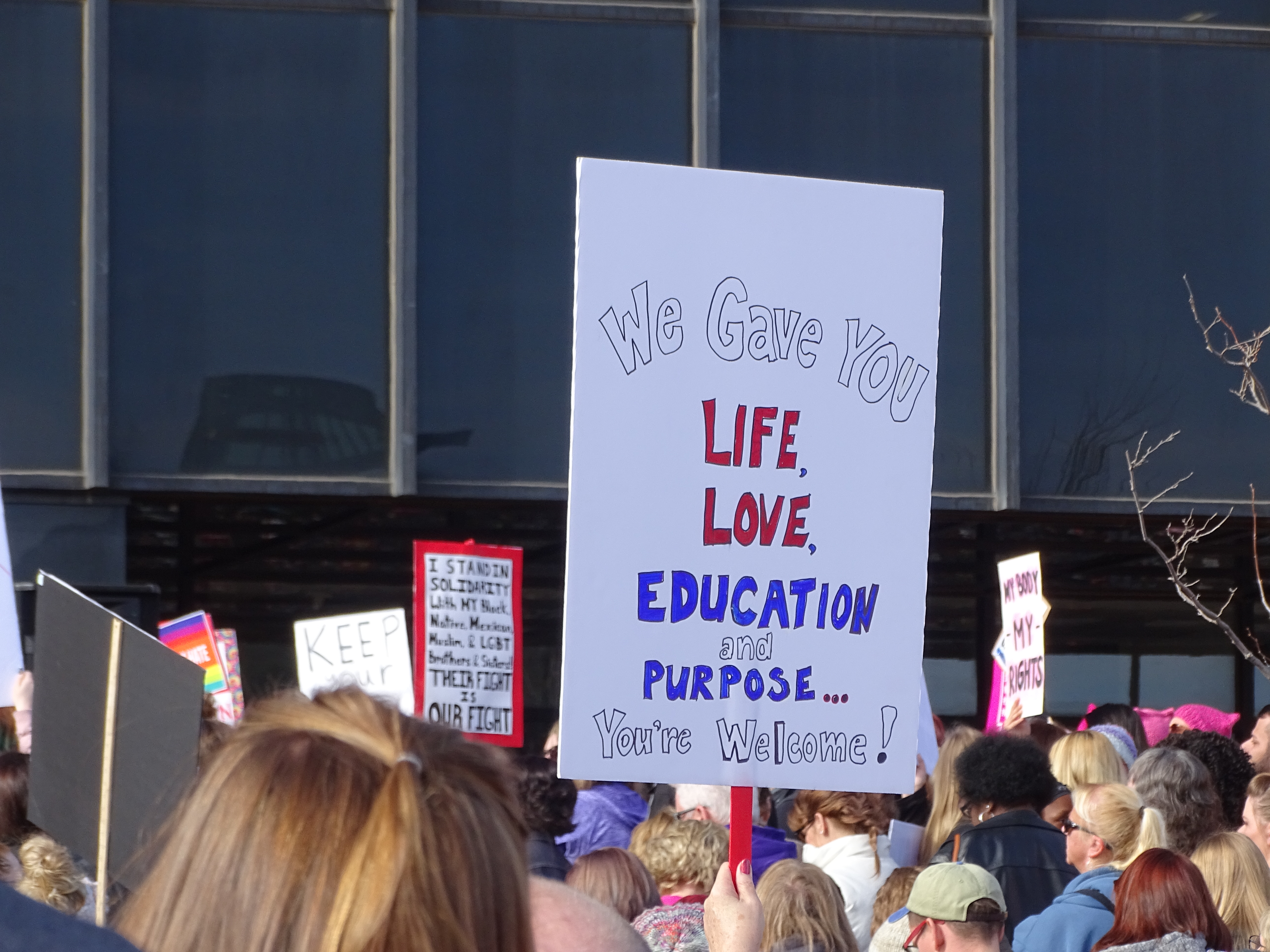
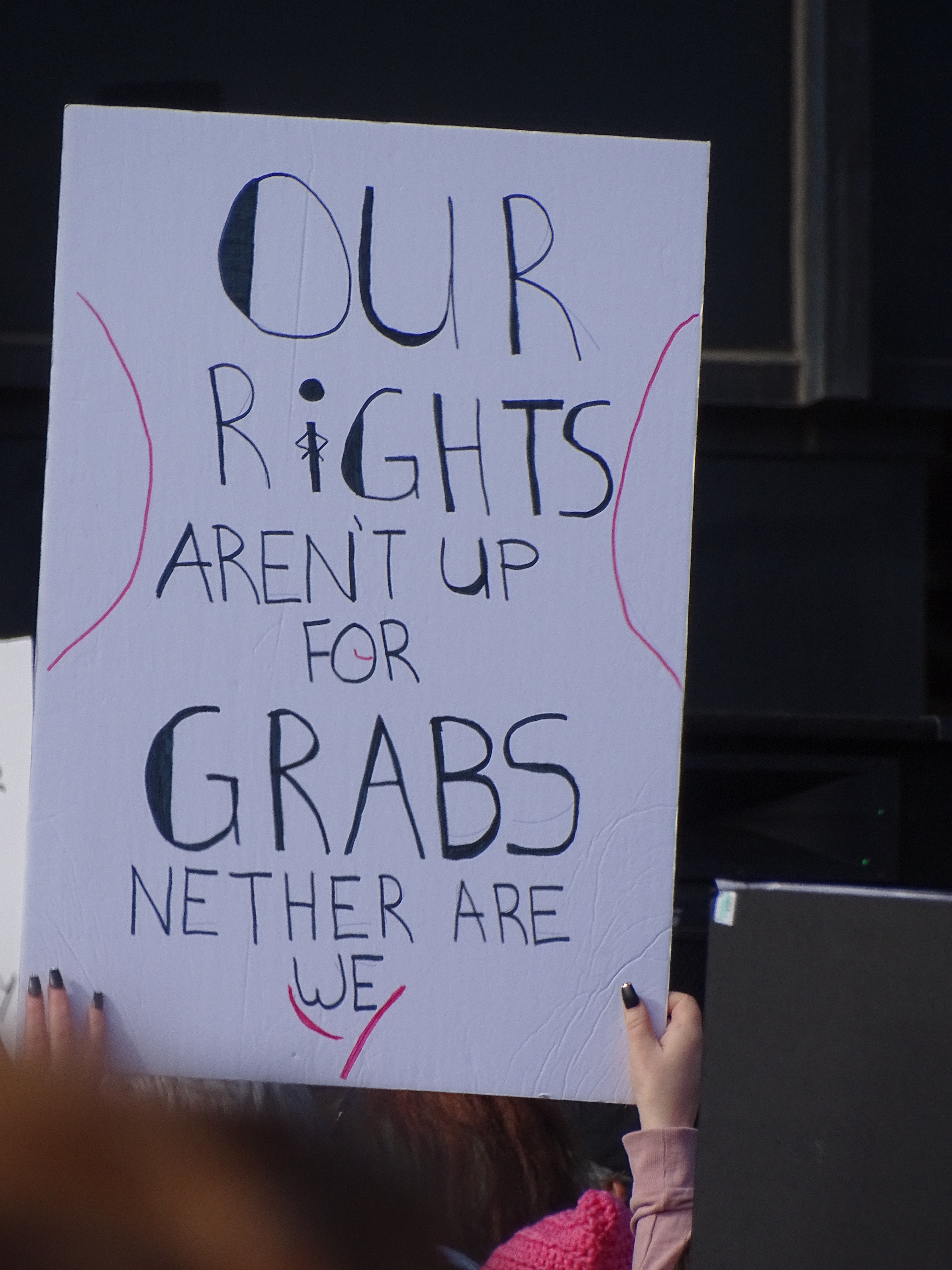
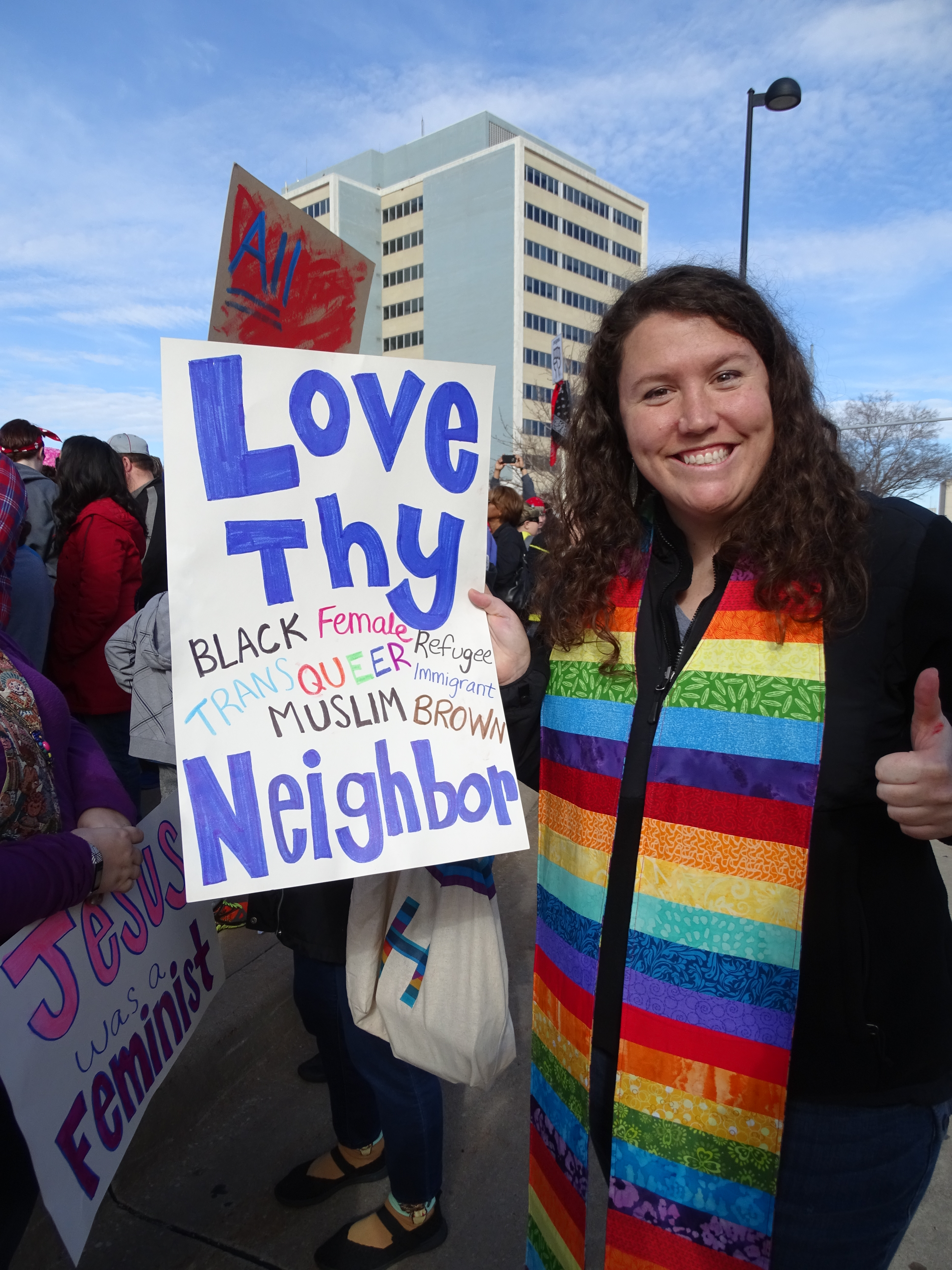
The signs held by many echoed every concern of the last year. When a couple of bystanders yelled opposition to the purposes of the march, they were ignored by all the rest. Over all, it appeared to be the perfect first step of peaceful resistance, an exercise of our first amendment rights on the first day of a new era, when the only way to go is forward.

dsc03350

Some of my favorite signs held these messages:

Respect Existence OR Expect Resistance


We’re Not Going Anywhere.                                       United Against Hate.


We love our Muslim Brothers and Sisters.           Deport Racism.

dsc03375Keep Your Laws Off My Body

I’m Muslim.                                                                                 Isis Doesn’t Represent Me or Islam

Black Lives Matter

We Stand with Standing Rock


Women March for Health Care

Girls Just Want to Have Fun-                               Damental Rights

The Brave Choose Love

Women’s Rights = Human Rightsdsc03376


Who Would Jesus Exclude?

Do Justice. Love Kindness. Walk Humbly. Micah 6:8

Hope Not Fear

Make America Think Again

Hear Our Voice

War is not Healthy for Anythingdsc03382

Marching for my Daughter:                                             Her Values, Her Voice, Her Vote, Her Choice

A Woman’s Place is in the Revolution

dsc03384Dark and Difficult Times Lie Ahead.                Choose Right, not Easy

I’m too clumsy to be around fragile masculinity

End White Silence

dsc03380

Never Doubt you are Valuable, Powerful and Deserving of every chance in the world.

dsc03383

And perhaps my favorite,                                        Building Bridges Not Walls

(more on that later)

A few speakers and musicians were lined up to address the crowd. Though hard to hear and understand, I was able to listen to one energetic woman. She shared motivational ideas that included this message,“Love one another. Share love, even in the tiniest ways. Smile at someone you don’t know. 

“This is why I fight. I fight for my daughter and my son—for everyone. Because it’s the right thing to do. We can’t go back. We need to move forward for a better America.

“If we stop trying we’ll never learn to walk. Sure, we’ll get knocked down. But we’ll get back up again. We the People hold our destiny in our own hands. We hold the power to affect the lives around us.

“In the words of a popular song, ‘I may have only one match, but I can make an explosion!’ Together we can be that explosion! Do not be afraid, for we were born to do this.”

dsc03345

As the marchers filtered back toward the origin of their walk, we listened to live musicians present the song, “R-E-S-P-E-C-T”. I left feeling energized and optimistic that we could hang onto the progress we’ve made over the last half-century toward inclusive human rights.

dsc03371


American Chess Game

american-chess

In recent weeks, overwhelmed by the gut-wrenching posts of gifted writers, I have written little worthy of sharing. But I spend hours reading what the rest of you write. And I hear you, friends. I share your pain. I understand the disbelief, the anger, the recurring horror following an election that spoke NOT for the majority of voters, but set us up for a nightmare administration that shakes us to our very foundations. We do, indeed, grieve.

Chatting with my thirty-something son yesterday, he shared his disappointment. “I really thought we were better than that, as a nation.”

I thought so, too. I grew up believing that we, as Americans, stood for progress, for humanitarian support around the world. Through our influence and assistance, we could help other people achieve the freedom to speak for themselves, without fear. When I was a child, I felt pride in my country. That is not the case today.

Echoing a dear friend, I say, “I so want us to be the good guys.”

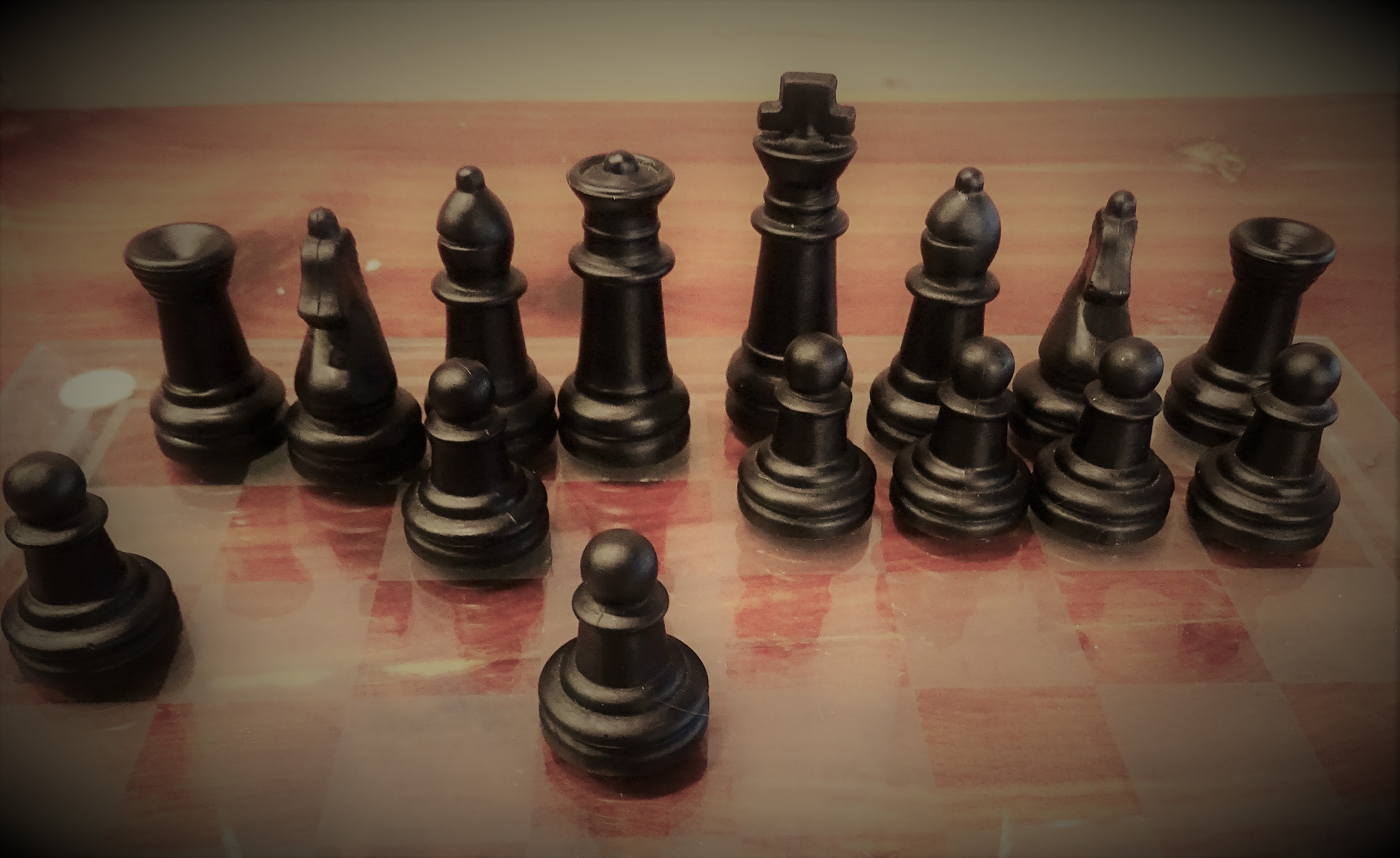
Yet now, it seems even though the majority of us still subscribe to decency, integrity and honesty, it matters less than if you have a lot of wealth and can buy your way into a misleading and dangerous leadership position. This is what happens when there is only one recognized litmus test for success and that test is money. Those with a lot of money control the game. The rest of us are pawns. We’re expendable. It’s a big game of power and apparently it’s been going on for decades.

Two weeks ago, on a long flight returning to the US from abroad, I chose to watch a movie on my seat’s private screen. All the President’s Men was available. Remember that one? It was the true story of two reporters in Washington DC who uncovered the Republican Party’s involvement in and cover-up of highly illegal activities intended to manipulate and influence the election in 1972. I was a high school student then, a member of my school’s Teen-Age Republicans. Watergate became a huge story. As a youth, I had no real idea what it meant, but it ended Nixon’s term early.

Watching the movie in 2017, all I could think was—“Republicans have been manipulating elections through any means available to them for a LONG time.”

To what end? This morning I read a post by Jon Perr, “The simple, sinister reason for the GOP’s never-ending war on Obamacare”. He described how the recent attack on the ACA was not an attempt to promote a better system or better care for millions of American people. There is nothing proposed to replace the contentious health care act. Indeed, the number-one reason Republicans chose to repeal Obamacare was apparently to stifle public approval and support for their opponents, the Democratic Party.

We are indeed pawns in a mega-chess game of power.

No wonder we grieve. We have suffered great loss. No stranger over the years to heart-wrenching farewells and grief of many origins, I recognize that our national reaction to events in Washington DC reflects many facets of loss. What are some things we have lost? Beyond the assurance that our healthcare needs will be answered, we grieve for much more.

We have lost the leadership of a remarkable president who consistently demonstrated his dedication to the welfare of our people and others around the world. Instead, through some political shenanigans, the reigns are handed to a tyrant who seems to care little for the majority of the people.

We’ve lost faith in the ideals and processes of our people-driven government. What might have been and where could we be now if, instead of choosing every action to make the people’s president fail, our senators and representatives had worked together for our common good? What might we have become over the past eight years? We will never know and can only wonder.

We’ve lost our belief in the basic goodness of humanity.

We’ve lost hope for the betterment of our future, for the preservation of a pristine and sacred planet to pass on to our grandchildren.

We’ve lost a dream of a future where each of us is treated with respect and dignity, and all things matter on a healthy and robust planet.  Instead, we have a vision of an Earth such as the one Wall-E was cleaning in the animated movie, because all that matters is money. Who has the most money and how will they use it to manipulate us pawns for their own greedy ends?

It is no wonder that we grieve. Loss of a dream is hard.

As a novelist, I find myself pondering some of the plotting techniques I learned in workshops over the past few years. Consider, for a moment, that we are collectively the protagonist in an edge-of-the-seat thriller story. The poor protagonist experiences set-back after set-back, crisis after crisis, conflict after increasingly intense conflict. Just when you think you’re in the clear, you’re not. (Election of Barack Obama as US president.) Just when you think it can’t possibly get worse, it does. (Inauguration of Trump, and his cabinet choices.)

Collectively, as a character in an on-going drama, we are riddled with internal conflict. The election of November 8, 2016  is one giant plot twist, catapulting us into the final climactic scenario. How will we cope? Can we find the means to pull through this era of consternation as a better nation? Will we even survive?

We pawns must write the ending to this story. Recently a Facebook friend shared a thought about grief. “Grief is really just love with no place to go. It’s all the love you want to give, but cannot.”

The way to move ahead is to find new avenues to spend that love, in honor of those people, dreams, or ideas we have lost.

I sometimes have the opportunity to counsel others working through grief. It’s hard. There’s no denying that. The event, the compound losses, have changed our lives. It’s up to us what we do now. We can work through it, and become stronger in the process. Or we can wallow in it and drown.

We can either let our grief make us better people and a better nation, or we can let it break us.

I choose to let it make us—make me—better. I’m not off the board yet. I may have little or no influence in Washington’s big game, but I can influence my home and hometown. The question is, “How?”

I refuse to be overcome by fear and suspicion of neighbors and family members on the other side of issues. I can choose to share love, to smile at strangers, to listen with compassion. I can increase my support of humanitarian causes, here at home. I can be an ambassador of goodwill wherever I may go. I can support the ideals of freedom and equality. I can defend the first constitutional amendment just as adamantly as others have defended the second amendment.

(Amendment I. Congress shall make no law respecting an establishment of religion, or prohibiting the free exercise thereof; or abridging the freedom of speech, or of the press; or the right of the people peaceably to assemble, and to petition the government for a redress of grievances.)

I can march in a near-by Sister March on Saturday morning, a peaceful way to celebrate human rights, diversity, freedom, and equality for all. (www.womensmarch.com)

Who knows, if pawns in every hometown opted to spread goodwill, understanding, and justice, maybe the sorry protagonist in this suspenseful story will manage to pull through and save the day after all.

Do you have ideas about ways to resist with love and compassion? If so, please share them in the blog comments. If you’re shopping for more great ideas, check out  johnpavlovitz.com/2017/01/14/10-acts-of-resistance-on-inauguration-day

Christmas Wish List for Writers

If you’re wondering what to get for your writing friends for Christmas, there are a few simple things we might all really enjoy. No sweaters, fruitcakes, or winter robes. Forget candles and do-dads.  Jewelry doesn’t make the list. Actually the items on my list don’t really cost anything at all, but possess a value beyond dollars and cents. If you want to make a writer happy, consider the simple things on this list:

dsc02137First. Take the time to read what we write. Nothing pleases me more than to know I have published something that you enjoy reading.


dsc02134

Second. Tell me what you think, particularly if you have enjoyed the book. Though constructive criticism is welcome too, I treasure the collection of notes that have filtered in affirming that my efforts have been appreciated by readers. Among them:

Locally: “I started reading the evening I bought the book. I had to force myself to put it down after the first few chapters and pick up the comics to read so that I would be able to sleep. The next day, I let myself finish it. Wow, what a ride!”

From New Mexico: “I wanted you to know how much we enjoyed your books. Both were page-turners and I was sorry to finish them!”

From Wichita: “Sundrop Sonata kept me intrigued right up to the end. Glad I bought the book.”

From a friend at church: “Do not ever stop writing!”

From Facebook friends: “Finished reading Sundrop Sonata a few days ago. Ludlum and Clancy have nothing on you. It kept me engaged and intrigued to the end. Well done.”

Facebook: “I downloaded your book Sundrop Sonata this afternoon. I just finished it. Excellent!”

Facebook: “Loved your book! Lots of great plot twists, and of course I appreciated the solfege clue. ”

dsc02136Third. If you belong to a book club, submit my titles as featured books. Invite me to speak at your meetings. The actual writing is a solitary activity and I don’t get out much. Speaking engagements allow writers to meet possible readers, connect with new friends and share enthusiasm for literature.

dsc02135Fourth. Recommend the book to the rest of your circle of friends and family. Take it a step further and post reviews online, such as on amazon.com or goodreads.com. Times have changed since I was a young adult with the idealistic dream of writing novels. Today’s world is driven by online reviews. Writers greatly appreciate a short note about their books that anyone can see. Excerpts from my favorite reviews:

“Hold onto your seat. The story leaves the reader breathless and hopeful that Izzy has another heart-thumping adventure in the near future!”

“Isabel (Izzy) Woods is an engaging heroine with flaws and strengths wrapped in a core of determination. I loved her. More please…”

“Couldn’t put this one down! Exciting from the first page until the ending. A MUST read!”

“My test of a good read is looking up from the page and taking a second to figure out where I am and what I should be doing. It’s been a little while since I’ve been pulled in so thoroughly. Thank you for a great read.”

“I found this book a fun read. I am looking forward to Ann’s next book! The story engaged me from the first pages and I hardly had time to work until I finished the book!”

“Wow! What a story….packed with action, compassion and just enough of the technical workings of the piano to draw us in and keep us tied up to the very end. I look forward to another Izzy escapade!”

Sundrop Sonata  is a gripping, can’t-put-it-down novel. I must give a top rating to this thrilling adventure and look forward to Ann’s next work.”

“A whopper of a tale with plenty of twists and turns and suspense. Wheee! what a ride.”

“Excellent mystery story. Kept me on the edge of my seat from beginning to end.”

“This book was a fun and exciting mystery. I couldn’t put it down. I highly recommend Sundrop Sonata.

“Read it in one day. Just couldn’t put it down.”

“This was one of the most exciting and compelling mysteries I have ever read, and I have read a lot of good mystery books.”

“Best book I’ve read in a long, long time! I am totally sleep-deprived because I couldn’t put the book down. Just one more chapter…Ann, please write another book!”

“I looked forward to time to read more of it everyday, and now sorry it’s over! Look forward to more from this author.”

Okay. Let’s face it. I like all the reviews and I’m so grateful that folks enjoyed the book enough to write a note about it. It would be interesting now to see how many good reviews mentioning a movie it would take before—oh that’s just a bit over the top.

Still.

I do appreciate the feedback. For those who have requested another book, I want you to know I’m working on the next one, which brings me to the final item on my Christmas wish list.

dsc02138Fifth. Time. Oh how I wish I had more time to spend sorting words, knitting them together, and dreaming up the next adventure for Izzy and her family. If you know how to increase the available hours in any day, please send me a few.

dsc02141

Ann’s books may be ordered here:

http://www.amazon.com/dp/B01AZUMTZS

http://www.amazon.com/dp/B00NUA5VVU

Possibilities!

It’s exciting to be invited to participate in the Kansas Library Association’s 2016 Author-palooza. In addition to presenting their books, authors are instructed to share their experiences in presenting public programs.

I have been amazed at how many opportunities opened for me after my memoir was released. This is a new chapter in my life, and a very rewarding one to be sure.

Here’s my list of appearances:

In the Shadow of the Wind readings and inspirational programs on grief and healing

perf6.000x9.000.indd
http://www.amazon.com/dp/B00NUA5VVU

October 23, 2014  Grace United Methodist Church discussion

March 7, 2015       Douglass United Methodist Women spring tea

April 25, 2015       Fredonia First Baptist Women spring tea

May 6, 2015          Potwin United Methodist Women spring tea

July 10, 2015         Writers of the Wheat, Sunflower Plaza, Wichita

October 7, 2015    First UMW, Arkansas City, meeting program

October 14, 2015  Rose Hill UMW, meeting program

January 17, 2016   Howard and Severy UMC Sunday guest speaker
January 21, 2016   First UMW, Winfield, meeting program


Suspense Fiction (Sundrop Sonata) and writing programs

Sundrop Sonata Cover
http://www.amazon.com/dp/B01AZUMTZS

May 6, 2016          Winfield PEO: “The Legacy of Words,” featuring the WWII letters of my uncle Lester Harris, posted on my blog.

June 11, 2016        Kansas Authors Club, District 5 program, “Using Fiction Techniques in Writing Memoirs”

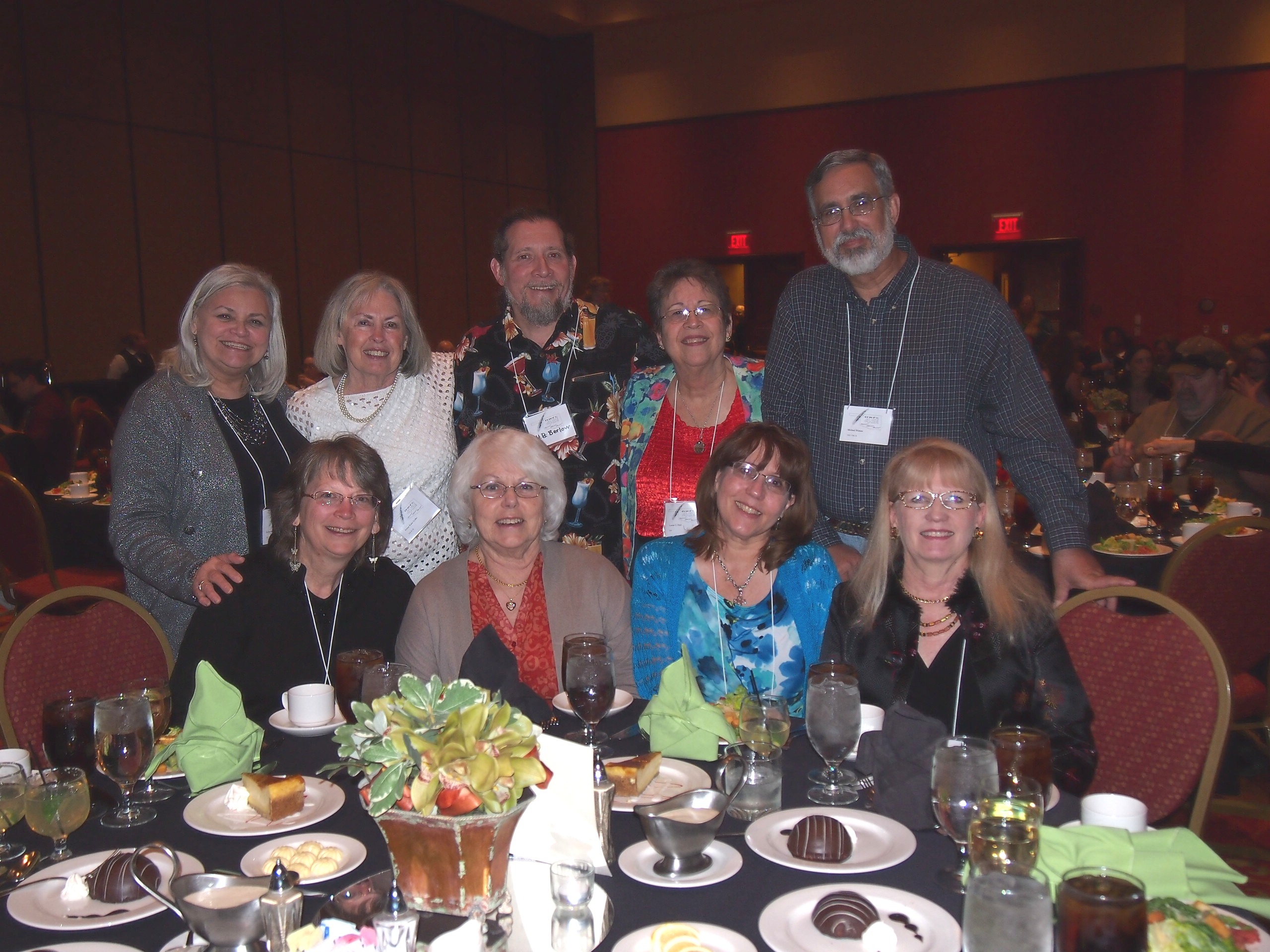
October 2, 2016    Kansas Authors Club, annual convention, “Note by Note/Scene by Scene: Crafting a Suspense Novel”

And the adventure continues!


Note by Note and Scene by Scene–Suspense Novels: Part 4

Polish for Perfection

After you complete the novel’s first draft, then what? The next steps are the hardest work involved in writing a book–re-writing, revising, and editing. Check every chapter, every scene, every sentence and every word. This is grueling work but it must be done.

There are some steps to take which will be helpful. They involve calling in the troops. Build a network of folks who will support your efforts, even as you support theirs.

OLYMPUS DIGITAL CAMERA

Critique Groups

Join a critique group in your writing organization. Reading critically to help others is a wonderful way to learn to look at your own writing with critical eyes. As you help your friends, they can read selections you send them and all of you benefit.

Attend Writing Conventions and Workshops

You should be able to find several conventions or workshops that cater to your interests. Select classes or workshops that speak to your needs. It’s possible you will meet some other writers who will become fast friends. If your local group meets regularly, request programs that will benefit your endeavors.

dsc01768

Beta Readers

When you have gone over the draft about fifty times and you think it’s nearly ready for release, it’s time to call in a team of Beta Readers. These would be folks you trust to read the entire novel with a critical eye to find any errors you might have missed. The readers could be fellow writers, but you might also wish to draw from your other circles to find out if you have missed any technical details from their fields of expertise. For Sundrop Sonata I used several writing friends, but also some people who just love to read, a young man who knows personally what it’s like to deal with Asperger’s Syndrome (who is also a gifted writer), a friend who is a native of New York, another piano technician, a drama specialist, and a military man who knows firearms.

Listen and Learn

Once you have delivered copies of the novel, or specific sections, for critical review, the next step is most important. Be prepared to listen to any and all suggestions for editing changes that your valued readers offer. There is probably no book written that can’t be improved in its early phases, and you certainly don’t want to release your book before you’ve done everything possible to smooth over the hiccups.

Much of my research for Sundrop Sonata came through years of full-time work as a rural piano technician. When I tune a piano for a client, the objective is to produce a harmonic instrument, something better than what I started with. Since I’d like the piano owners to call me back again in a few months, I strive for the very best result possible.

Consider that most pianos have 88 keys. What many people don’t realize is that most of those 88 keys operate mechanisms that end up striking and playing 3 strings simultaneously. Thus, on your average piano, for the 88 keys, a piano technician ends up tuning about 220 strings. This number varies due to the design and size of pianos, but let’s just say 220 strings need to be in tune with each other when I’m done with a piano call.

What if I end up tuning 219 strings perfectly, but leave one untuned? I have a piano that is 99.5% tuned. Pretty good, right? Almost 100%.

When I was in school, the grading scale was something like 90 to 100% considered excellent work, and earned an A. 80-89% was a B. 70-79% a C. Remember those days?

That’s not the way it works in the real world. If I tune a piano with 219 out of 220 strings perfectly in tune, and miss just one, I have a piano that is 99.5% tuned. But it is that one sour string that will draw attention, and the pianists will say, “She doesn’t know how to tune a piano.”

In other words: 99.5% is FAILING in the real world.

IMG_0029

As writers, we need our work to be 100% complete. If there is one little hiccup, that is what readers will notice. The process of re-writing and revising can’t be more important, and ultimately, it is the author who will receive credit (or blame) for the book.

With piano tunings, there is room for some disagreement about what might be considered “perfect”. Likewise, there are various opinions about choices writers may make that would lead to smooth reading. Absolute perfection is an elusive and impossible goal. Still, you want to smooth out as many hiccups as you possibly can before turning the book loose on your readership.

The month of November is National Novel Writing Month. (NaNoWriMo) If you are aspiring to complete a draft of a story that is forming in your head, I wish you many productive days that result in an excellent book. I hope to be working on a sequel to Sundrop Sonata  myself, so let’s write together!

Thanks for taking the time to ponder my musings. Hope you found something helpful in these last few posts.

Find Sundrop Sonata here:

http://www.amazon.com/dp/B01AZUMTZS

Note by Note and Scene by Scene–Suspense Novels: Part 3

Hook ’em and Reel ’em in

Layers of Conflict

Within the pages of a suspense novel, readers will be increasingly concerned about several areas of conflict the characters face. This conflict arrives in several categories, or layers.

The obvious first layer of conflict is an external one, where the protagonist and antagonist come up against each other with conflicting goals in mind. They provide a source of conflict for each other that escalates throughout the story until they meet one-on-one and face-to-face with only one of them going to come out okay.

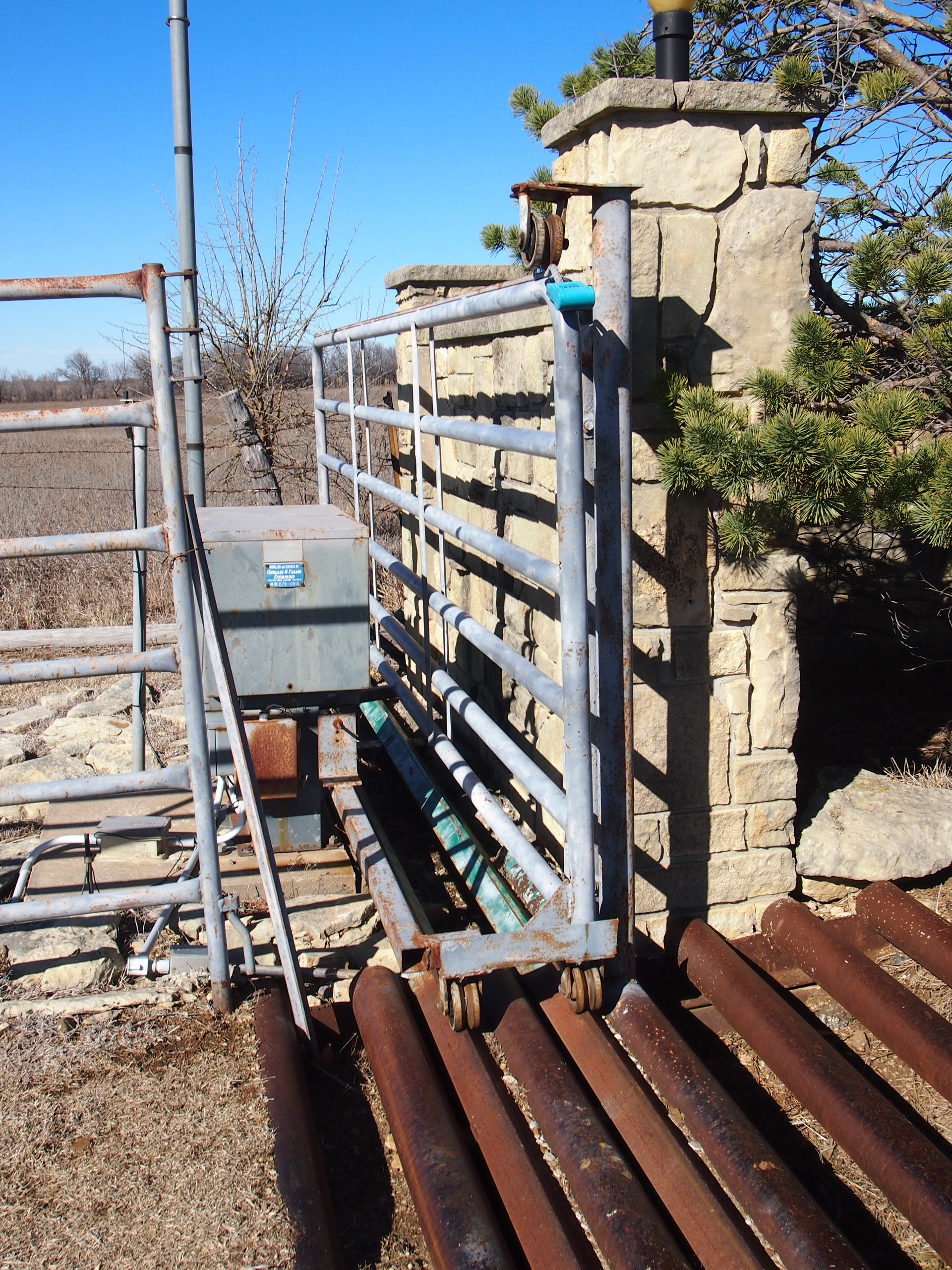
The gate

In Sundrop Sonata, the external conflict that Izzy faces starts from the first pages, when Nola begs her to leave the ranch, taking the child Laura along. Izzy is confronted with the need to save the child, though from what she doesn’t really know. Later, through various anomalies she discovers in a number of local pianos, she comes to understand that there is also a threat to the country–her neighbors, family, and friends. Both threats seem to be linked in some way to the same man, Laura’s father.

As the story progresses, a box of unknown substance from a backyard laboratory comes into Izzy’s possession. She doesn’t know what it is, but assumes it could be very bad and should not be left unattended in a crowded parking lot at a music festival. When she learns that her nemesis has abducted her own daughter, the conflict escalates once again. He has made it personal and brought the threat into her own family.

In the concluding scenes, Izzy and Jay meet face-to-face in a dark piano repair shop where she must find a way to stop him and thwart his agenda, or die trying.

Internally, each of the three viewpoint characters faces challenges of their own. Jay struggles with recurring nightmares of his past life. Laura must come to grips with the loss of her mother, the most important person in her young life. And Izzy struggles with self-doubt about her own ability to find the strength needed to persevere.

On a personal level, Jay must face his sweet mother and convince himself that his actions–whether she approves or not–are in her best interest and defense. Izzy faces marriage unrest, compounded by the actions and temptations of another man.

Each layer of conflict for the characters intensifies as the story progresses. Even when young Laura seems to find safe haven with family in the east, it becomes clear that she is not yet safe from Jay.

The ticking clock

The needs and goals of each character, whether external, internal, or personal, have to meet one other requirement. There is a deadline by which everything must happen. As the deadline approaches, the activity escalates as well.

A few years ago, in mid-September, I discovered an interesting plant in my flower circle. It was a thin green spike with a mass of narrow scarlet petals cascading from the top. I’d never seen anything quite like it, though it did resember the pink surprise lilies that bloom in the summer. My first thought was that some of those pink flowers had evolved into this fall-blooming red version. Through subsequent years, I discovered that the red lilies also had a late froth of narrow green leaves that stayed green all WINTER, but would shrivel up and disappear with the arrival of spring. One could forget they were there until September when the flowers reappeared, with no leaves.

I called this flower a red spider lily. The fact that it bloomed in September, coinciding with the local music festival, made it appropriate as a deadline tool in the fictional story. Later, I discovered that I did not have anything unique. There really is a flower, more of an amaryllis than a lily, that other people have also called “red spider lily”.  The flower comes from Asia, (how convenient) and its technical name is Lycoris radiata.  It was perfect–easy to hide in someone’s flower garden, always blooming at the same time of the year, and hidden most of the rest of the year. The red spider lily became a ticking clock.Red Spider Lilies

Building suspense

When writing a suspense novel, you want to invite readers to continue reading from the very first page. I would even go so far as to say, dare the reader to stop reading! The opening line is critical to keep folks reading and wondering what will happen next. Put a lot of time into crafting the perfect opening line for your story. It may not take you eight years, like it did me, but spend some time on the opening line.

Some of my favorites opening lines:

It was a pleasure to burn. (Ray Bradbury, Fahrenheit 451)

I was not sorry when my brother died. (Tsitsi Dangarembga, Nervous Conditions)

First I had to get his body into the boat. (Rhian Ellis, After Life)

There was a time in Africa the people could fly. (Sue Monk Kidd The Invention of Wings)

Once you have the opening, take care with endings too. Readers should want to keep reading when they get to the end of a section or chapter. Make them wonder how it’s going to turn out. Tease them along by presenting more tantalizing questions or raising the stakes at the close of a scene. It’s kind of like a fishing expedition. First, hook them with the perfect opening line. Then tease them along to keep them reading. Make them turn the pagess

The use of multiple viewpoints in the “sonata format” allows multiple cliff-hangers in each chapter. You can leave one character in a formidable place and start a section with another of the viewpoint characters, moving their story along. Little by little, the questions are answered, and conflicts resolved, even as new challenges and questions arise. The final scene makes everything  clear to the characters and the reader as well.

s05

Stay tuned for the final part of this series on Suspense Novels: Polish for Perfection.

Find Sundrop Sonata here:

http://www.amazon.com/dp/B01AZUMTZS


Note by Note and Scene by Scene–Suspense Novels: Part 2

DSC00735

Memorable characters

The characters you create live the story. There will be major players—the protagonist and her adversary the antagonist, several second tier characters who make appearances to enhance the unfolding drama, and perhaps a host of mostly nameless folks who flit in and out of various scenes.

The major characters, and some of those on the second tier, will face challenges that escalate as the story progresses. Those challenges need to be logical for each character, given their personality strengths and weaknesses.

Each character should have strengths as well as weaknesses. No person is perfect. Neither should a fictional character be perfect—not perfectly charming or perfectly evil. Even the antagonist must have some redeeming qualities.

This is where some folks shake their heads and ask, “Exactly what is redeeming about Jay Pack?”

I admit he’s pretty far gone. But as his story is revealed, it’s obvious that he’s been the victim of bullies around the world. We can empathize with the boy Jay, and realize that bullies can create monsters more sinister than themselves. Jay also has a soft spot for his mother.

The Name Game

Once during a read-around at a writer’s meeting, I shared the opening scene of Sundrop Sonata. Afterwards, another writer came up and insisted, “You have to change her name. There really WAS a Nola Pack in Winfield when I lived there.”

I gave this some thought and decided not to change the name of this minor character. After all, I didn’t personally know a Nola Pack. The person she referred to was an acquaintance from forty or fifty years previously. I picked the name “Nola” from the title of a piano solo I have enjoyed since my teen years, and the “Pak/Pack” name was selected from a Korean/English dictionary as one that would easily be anglicized.

About the same time, I was reading a novel by my friend Mary Coley, in which the bad guy had the same name as my first father-in-law. Was I offended? Certainly  not. After all, Mary could not have known this name meant anything to me.

As writers, we have the glorious opportunity to select names for a whole host of characters. Parents agonize over names for their newborns. Multiply that agony by the number of characters in a book and you begin to see what a challenge naming characters can be.

I have a few guiding principles for selecting names. First, I want to stay away from names of people I actually know, or that are identifiable. Second, I don’t want to pick something so unusual nobody can pronounce it. With billions of people on the planet, the idea of picking names that are unique—that belong to nobody in real life—is a long shot. How many people share your name already? Have you ever done a search on Facebook for yourself? I share my  name with a dozen or so other women on Facebook alone.

In the selection of character names for Sundrop Sonata, I chose some common first names paired with surnames that sometimes show up in my family history, or in a dictionary, or are cities on a map. Traveling often inspires new words and names for use in the stories writing themselves in my head.

If you encounter a book with character names you recognize, don’t take it personally. Just enjoy the story.

PICT1062

Viewpoint

Somewhere in the writing process, the writer must decide which character, or characters, will tell the story. I struggled a long time with this, writing and re-writing the opening scene about fifty times over the course of eight years. I couldn’t seem to get beyond chapter one.

Then, in a writing workshop, I encountered the idea of using several viewpoints, and even different voices. The use of three viewpoints answered my challenges. Izzy’s first person narrative is mingled with the thoughts, plans and dreams of two others in third person (Laura and Jay). There were just too many things Izzy would not have known that were crucial to the story. Yet I found it impossible to tell her story in anything but first person.

Thus, Sundrop Sonata is written with three viewpoints and a mix of first and third person voices.

A good friend reviewed the novel in the Piano Technician’s Journal. In her review, she raved about the “sonata” format, using this trio of voices. A sonata is defined as “a musical composition, usually for solo piano, in three or four extended movements contrasted in theme, tempo, and mood.” With the three different voices filtering through the story, each chapter becomes a literary sonata, or sonatina, with the entire novel a sonata.

The sonata idea worked quite well in several ways. I’ll share some of them in Part 3, Conflict and Suspense.

Walnut Valley Festival

Find Sundrop Sonata here:

http://www.amazon.com/dp/B01AZUMTZS


Note by Note and Scene by Scene–Suspense Novels: Part 1

After the Kansas Authors Club convention in early October, some participants asked if I would post the content of my class online. The next few posts are in response to that request.

Sundrop Sonata Cover

I didn’t set out to write a suspense novel. There was a story in my head and it needed to be told. The genre identity was a puzzler for me. People suggested it would be classified as a mystery, and in a very broad sense, I suppose it is. But in a traditional mystery, the reader is presented in the beginning pages with a crime–often a murder–and spends the rest of the book analyzing characters and clues to figure out whodunit.

That’s not the way it is in Sundrop Sonata.  The reader knows early on whodunit but the protagonist does not. Indeed, the poor protagonist isn’t even sure what’s happened. The reader knows. The character doesn’t. This keeps the reader cheering for the innocent and naïve protagonist, wanting her to figure it out before it’s too late.

At the same time, nobody knows why the antagonist has acted so irrationally. In this story, motive is a mystery. The answer is to be revealed as the pages unfold.

How would you describe the difference between a mystery and a suspense novel?

Nola's deck

Plot

I like to think that from my very first memory, I have been conducting research for fictional stories. Everything I have ever done, every place I have toured, every age I have lived through–all things are ripe for plucking and setting into a new story.

I have lived almost my entire life on farms or in rural Kansas. But I have traveled extensively throughout the North American continent, as well as a few other places. My interests are many: music–piano music, handbells, symphonies and folk instruments as well.  I like the instruments themselves, especially piano technology and construction.

I have a deep love and respect for nature and the environment fostered from many camping vacations in the great outdoors. I chose science as a field of study in college, earning a bachelor’s degree in geology.

I have always loved to read, which led to my interest in writing. And I am a spiritual person with a focus on supporting and uplifting folks, especially those whom others may have looked down on.

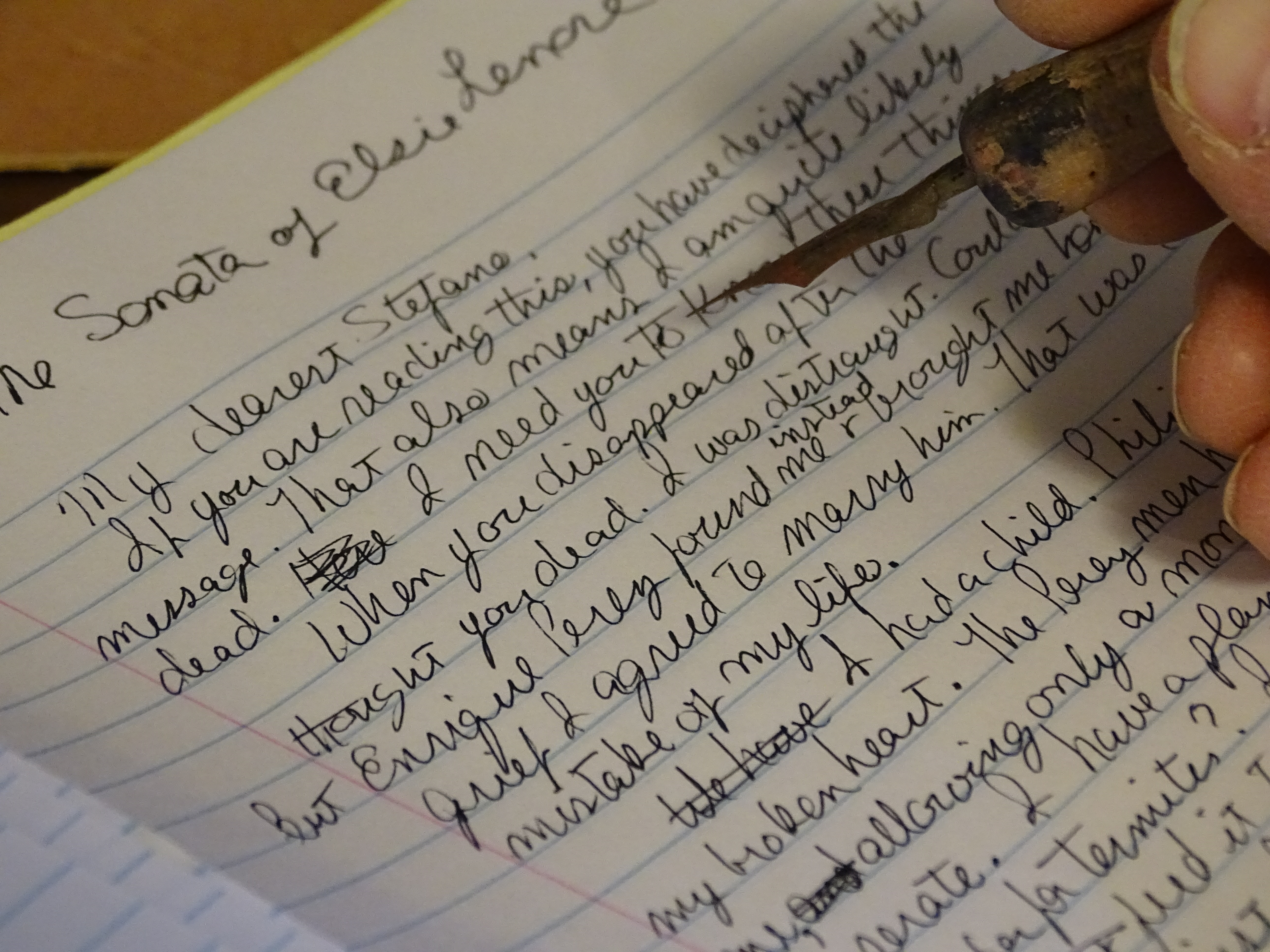
"The gate is open."

There are snippets of all these interests in the pages of my books. I never really know when a tidbit from my scientific training, for instance,  may collide with my love of music to weave a new thought into the plot of a developing story. It’s much like making a quilt–you find patches from various scraps of the past and stitch them together into a new creation.

To write a novel is to make a quilt from patches of the past.

What are the areas you take special interest in? What experiences filled your life that will provide background and ideas for your writing projects?

Given that each of us has different interests and different experiences, even if we start out with the same premise, we’d end up with an infinite number of fresh new stories. If I were to suggest that you take a product you know and love that is often imported from another country, and make that product a  vehicle for smuggled goods, what product would you choose? What is being smuggled into the country? How would it be hidden? Who is going to discover the plan? And what will they do about it?

No two quilts would ever be identical. We’d all have different stories to tell.

quilt-collage-2

(Stay tuned for Part 2: Character and viewpoint)

Words Unspoken

I did not have a chance to say anything at the awards banquet Saturday evening in Lawrence. Ronda Miller gave a nice introduction and then handed me the certificate for the 2016 J. Donald Coffin Memorial Book Award.

dsc01781

The J. Donald Coffin Award is intended to honor the best published book written by a member of Kansas Authors Club, within the last two years. This annual award is determined by independent judges who read the books submitted for consideration.

The trio of judges this year had this to say about Sundrop Sonata.

“It was captivating from the get-go and the intensity did not let up. There were many sub-stories going on simultaneously.”

“The multiple story line is what kept my interest and drive to keep reading and finish to uncover the resolutions. It was a hard book to put down.”

“I loved the portrayal of the child with autism, the piano notes and references, the insights into a unique job, the slight hint of romance, the twins who were separated, the murder, and the international plot that wrapped all of it together. This was a well-woven, intricately written book.”

It is an honor to receive the 2016 award for Sundrop Sonata. If I’d had the opportunity, here is what I might have said:

I am always amazed at the doors that open when I follow my dreams. At one point in my life, decades ago, I would have described myself as the world’s shyest person. I could not have dreamed of a moment like this. It just wasn’t possible. Even answering a question aloud as a high school student had my heart pounding so hard, I could hardly say a word. But I could write them.
Then I learned that life is short, and when opportunity knocks, you better respond, even if it goes against the core of your being–even if it’s the hardest thing in the world for you. And once I took that step, the doors opened.
Writing frees my soul. I’m never happier than when I’ve wrung the words to a particularly vivid scene onto a blank page. But then I found that after I wrote a book, people began asking me to speak.
Imagine that. Me, the shyest person on earth. However, the rewards of stepping out of my box, of trying something new, can be very worthwhile. It’s invigorating to meet folks who relate to experiences I have had, who know what it’s like, who are opening doors of their own.
I am not the first person to note that it takes a village to write a book. KAC is an important part of my village. Friends who write can offer each other valuable support, critique, and encouragement. I have learned a lot listening to honest suggestions from my writing friends. And I’ve learned even more reading their drafts and offering ideas to polish their work.
Thank you, KAC. Thank you, to the family of J. Donald Coffin. Thanks to my team of reviewers. Thanks to Ronda Miller whose sneaky little request for me to teach a class on suspense fiction preceded this award. (What? Public Speaking?)
Thanks to my family, several of whom attended the banquet with me. My sister—traveling across two states to attend the banquet. Cousins who opened their home to host the family this weekend. Special thanks to my husband, for offering ideas and tips in his specialty areas, for putting up with me and my crazy schedule, and for clearing his schedule to attend the banquet with me. He brought our live-in grandson along—thanks to the little guy for helping me in his special 6-year-old way.
To my fellow writers, I’d like to say, “Write those words whispering in your heart. Let go of them, and may many doors open for you!”

dsc01779